
Most benchmarks call a 25–30% hook rate good and anything above 45% exceptional. The ad we made with Retiplex for SpaServis, a hot tub service and e-shop in Slovakia, cleared that line by ten points, for a product almost nobody buys on impulse. Then it turned the attention into sales.
TL;DR: A good hook rate for Facebook ads is 25–30%, and 45%+ is exceptional. Our Retiplex ad for SpaServis, produced fully with AI in about an hour, hit 55.1% on cold traffic, drew a 4.41% CTR (all) and returned 5.5x ROAS. The script spent 54% of its words on the problem before naming the product, and half the orders were for a product the ad never showed.
What Is a Good Hook Rate for Facebook Ads?
Hook rate (or thumbstop ratio) is 3-second video plays ÷ impressions: the share of people who stopped scrolling. Meta doesn't show it by default, so add it as a custom metric in Ads Manager. There is no official benchmark, but most guides land in the same place (Motion calls 20–40% “generally solid”):
| Hook rate | What it means |
|---|---|
| Below 20% | Weak. The opening isn't stopping the scroll: fix it first. |
| 20–25% | Baseline. Keep it live and test new hooks against it. |
| 25–30% | Good. Iterate on the hook to push it higher. |
| 30–45% | Strong. Scale it if hold rate and CTR back it up. |
| 45%+ | Exceptional. Rule out flukes, then scale and clone the pattern. |
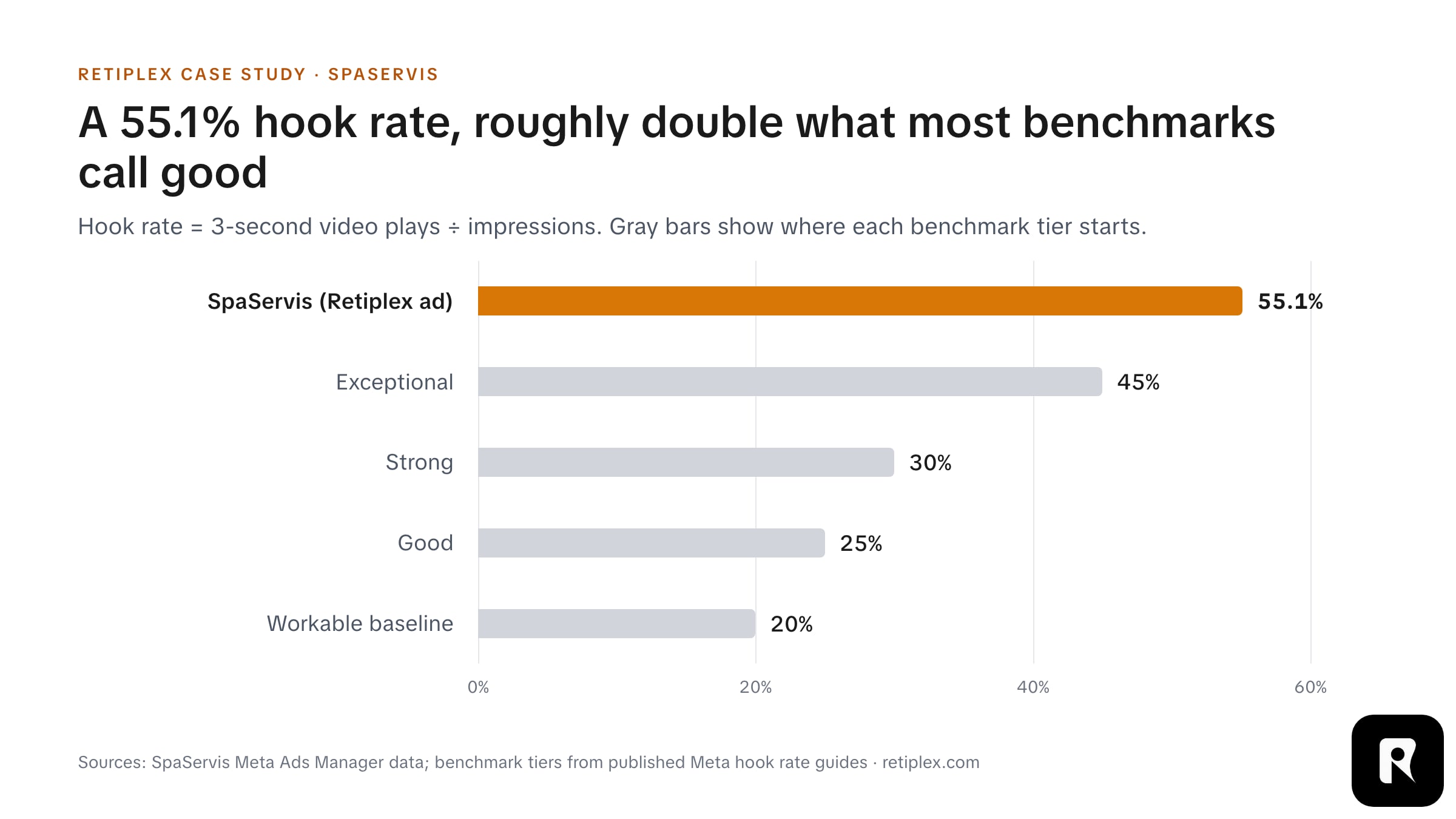
Compare like with like: Reels and warm audiences usually score higher than the feed and cold traffic.
The Campaign
SpaServis serves hot tub owners in Slovakia: holiday cottages, guesthouses, hotels and private homes. We advertised its COMPACT 1 spa cover lifter, an aluminum frame that lets one person lift a heavy thermal cover off the tub. On paper, a hard product for paid social: a narrow audience, a considered purchase and a small market.
We built the ad in Retiplex, which fully automates video ad production with AI. From product photos, it picks the angle, writes the script, casts an AI actor, records the voiceover and cuts in the product shots. No filming, no creators, no editor. The finished ad took about an hour, revisions included. We ran it as a single-creative test (one campaign, one ad set, one ad), so every number below belongs to this one video.
- Creative
- 1 vertical video ad, fully AI-produced in Retiplex (~1 hour)
- Angle
- Problem → Solution, first-person UGC-style testimonial
- Placements
- Facebook and Instagram, mostly Facebook; no Audience Network
- Audience
- Cold, frequency 1.25
- Optimized for
- Website content views (ViewContent)
- Attribution
- 7-day click, 1-day view or 1-day engaged-view
The Script Behind a 55% Hook Rate
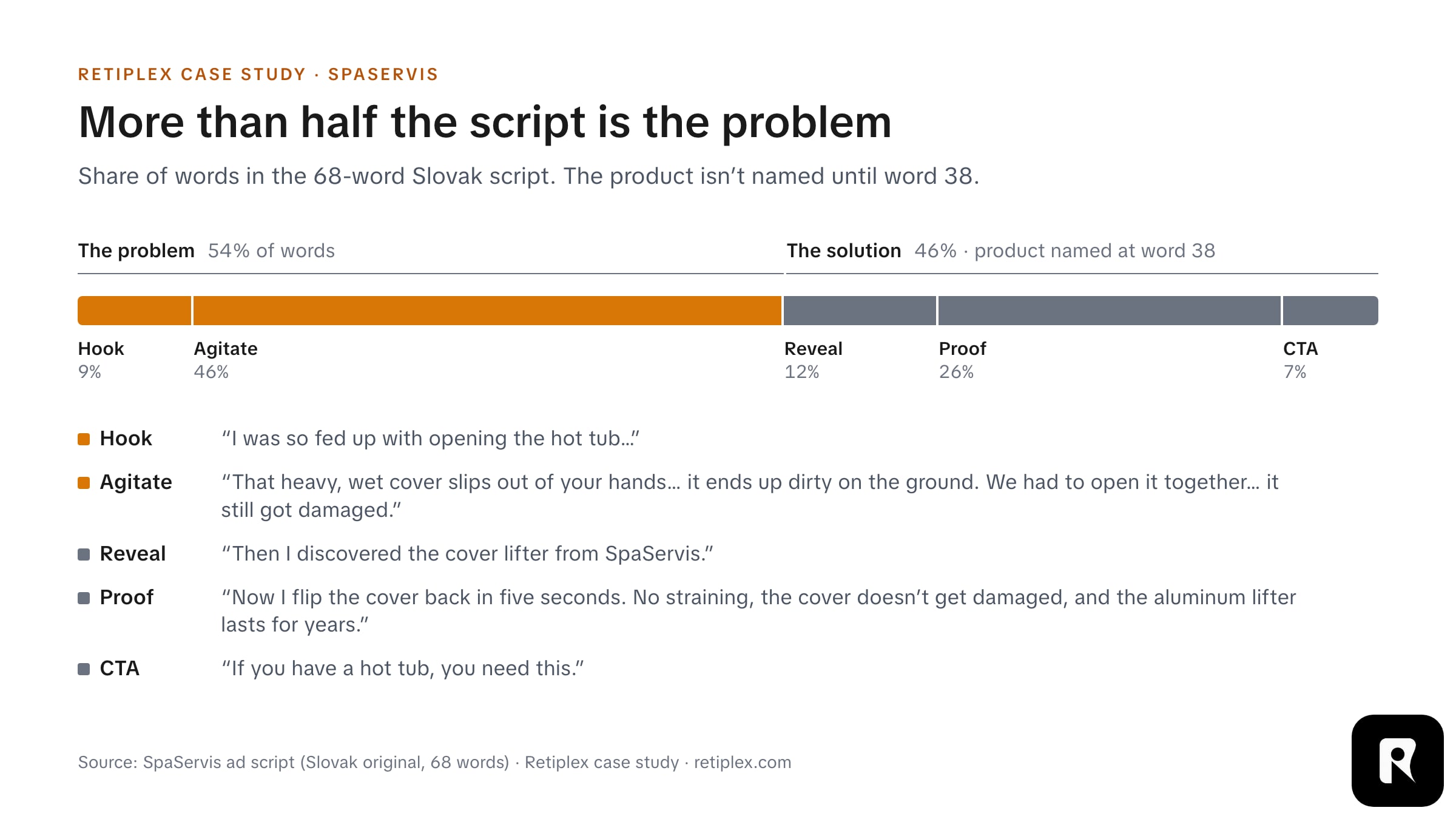
Translated from the Slovak original (68 words). It follows the five beats from our guide to making AI UGC ads.
Why it worked
- The hook is a feeling, not a product. No brand, no offer. Owners recognize the complaint before they register it's an ad.
- 54% of the script is the problem. Six physical pains (heavy, wet, nowhere to put it, dirty, a two-person job, damaged) before the product appears at word 38.
- Every pain gets a concrete answer, with a number instead of an adjective: “five seconds”, not “fast”.
- The CTA names its audience. “If you have a hot tub, you need this” filters the click to owners.
| Pain | Answer |
|---|---|
| Heavy, wet, slips out of your hands | “I flip the cover back in five seconds” |
| We had to open it together | “No straining” |
| It still got damaged over time | “The cover doesn't get damaged” |
| Will the lifter itself last? | “The aluminum lifter lasts for years” |
The Funnel: From Hook to 5.5x ROAS
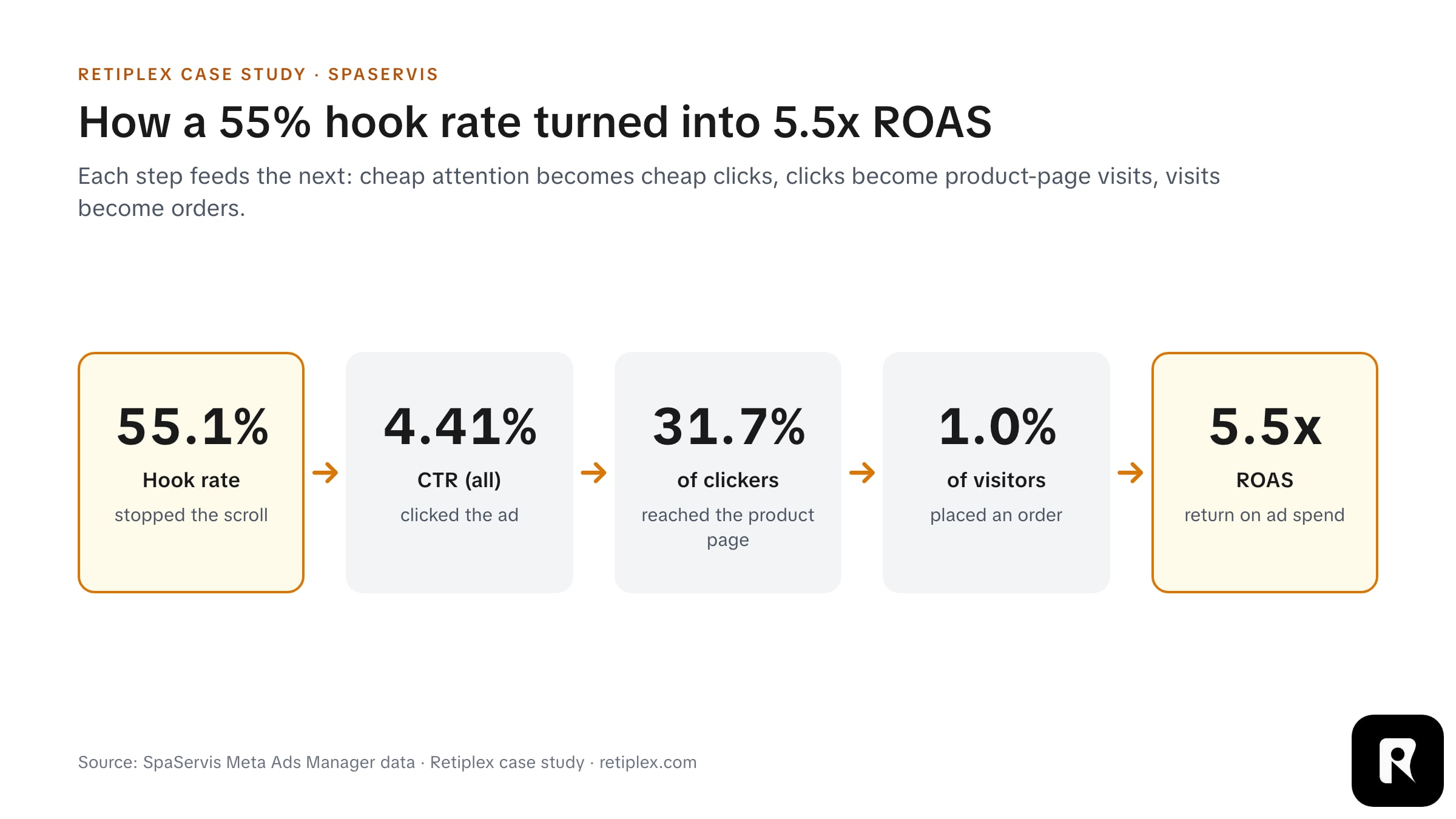
Meta's ad auction rewards creative people engage with, so a strong hook makes everything downstream cheaper: attention, clicks, product-page visits.
| Stage | Metric | Result |
|---|---|---|
| Stop | Hook rate3-second plays ÷ impressions | 55.1% |
| Watch | Watched to the end100% plays ÷ 3-second plays | 24.5% |
| Click | CTR (all)clicks (all) ÷ impressions | 4.41% |
| Click | Clicks per 3-second viewclicks (all) ÷ 3-second plays | 8.0% |
| Visit | Clickers who reached the product pagecontent views ÷ unique clicks | 31.7% |
| Buy | Visitor-to-order rateorders ÷ product-page views | 1.0% |
| Return | ROASrevenue ÷ ad spend | 5.5x |
- Where it won: the stop and the click. More than half the audience stopped, and 8% of them clicked.
- Where it leaked: only 31.7% of clickers reached the product page. Part of that is CTR (all) counting non-link taps, part is the usual mobile drop before ViewContent fires. Check mobile page speed before you blame the ad.
- Where it converted: 1.0% of product-page visitors ordered, solid for a considered purchase from cold traffic.
Is 5.5x ROAS good?
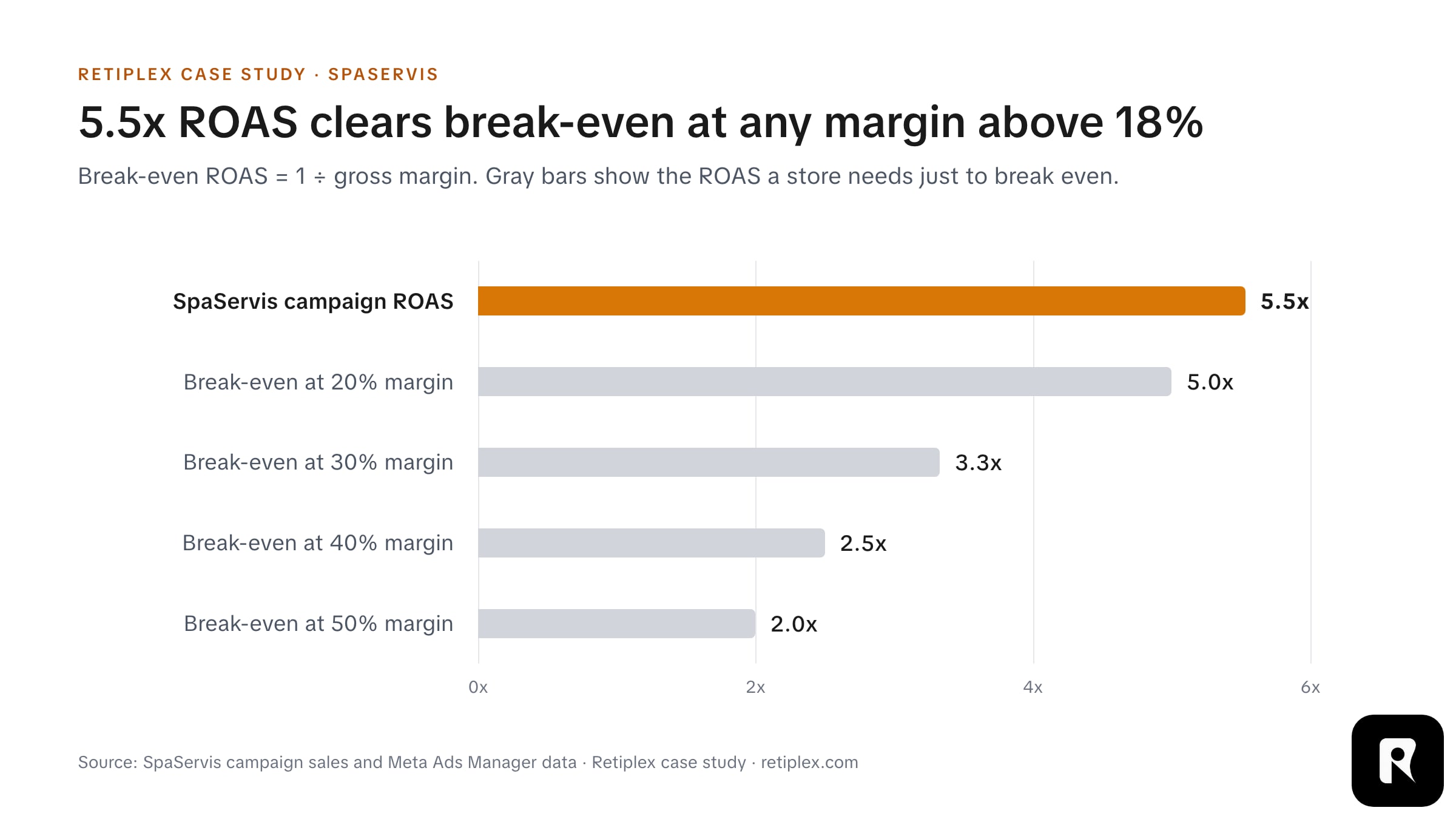
Only next to your margin. Break-even ROAS is 1 ÷ gross margin, so 5.5x is profitable for any store with a margin above 18%. The view windows in Meta's default attribution can over-credit, but the 7-day click window misses slower buyers of a considered product, so we read 5.5x as fair.
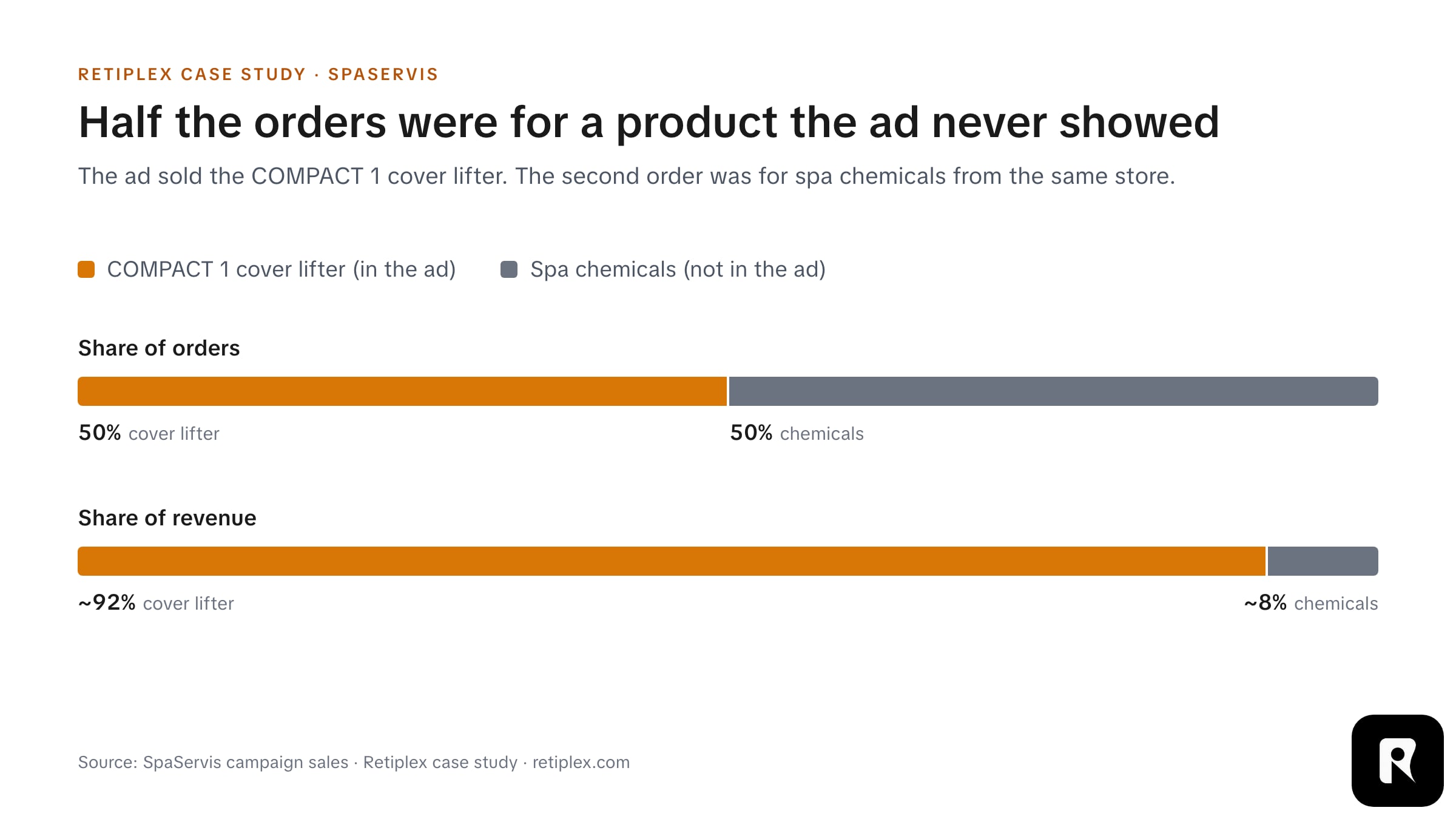
Half the orders were for a product the ad never showed
One half of the orders was the advertised lifter. The other half was spa chemicals. Someone who stops for a cover lifter owns a hot tub, and hot tub owners buy water care every month. Judge prospecting video on store revenue, not just the SKU in the ad.
Is a 55% Hook Rate Real?
A number this far above benchmark deserves suspicion. Four checks:
- Fresh viewers. Frequency was 1.25, so most people saw the ad once. Hook rate decays as frequency climbs; this proves the opening works on cold eyes, not that it holds at frequency 3.
- Cheap market. Slovak CPMs are low, so judge the creative on ratios like hook rate and CTR, not on cost metrics.
- No placement tailwind. Most impressions ran on Facebook, not full-screen Instagram Reels, and Audience Network was excluded.
- CTR (all), not link CTR. It counts every click, so compare it with CTR (all) from your own account.
Hook Rate vs Hold Rate
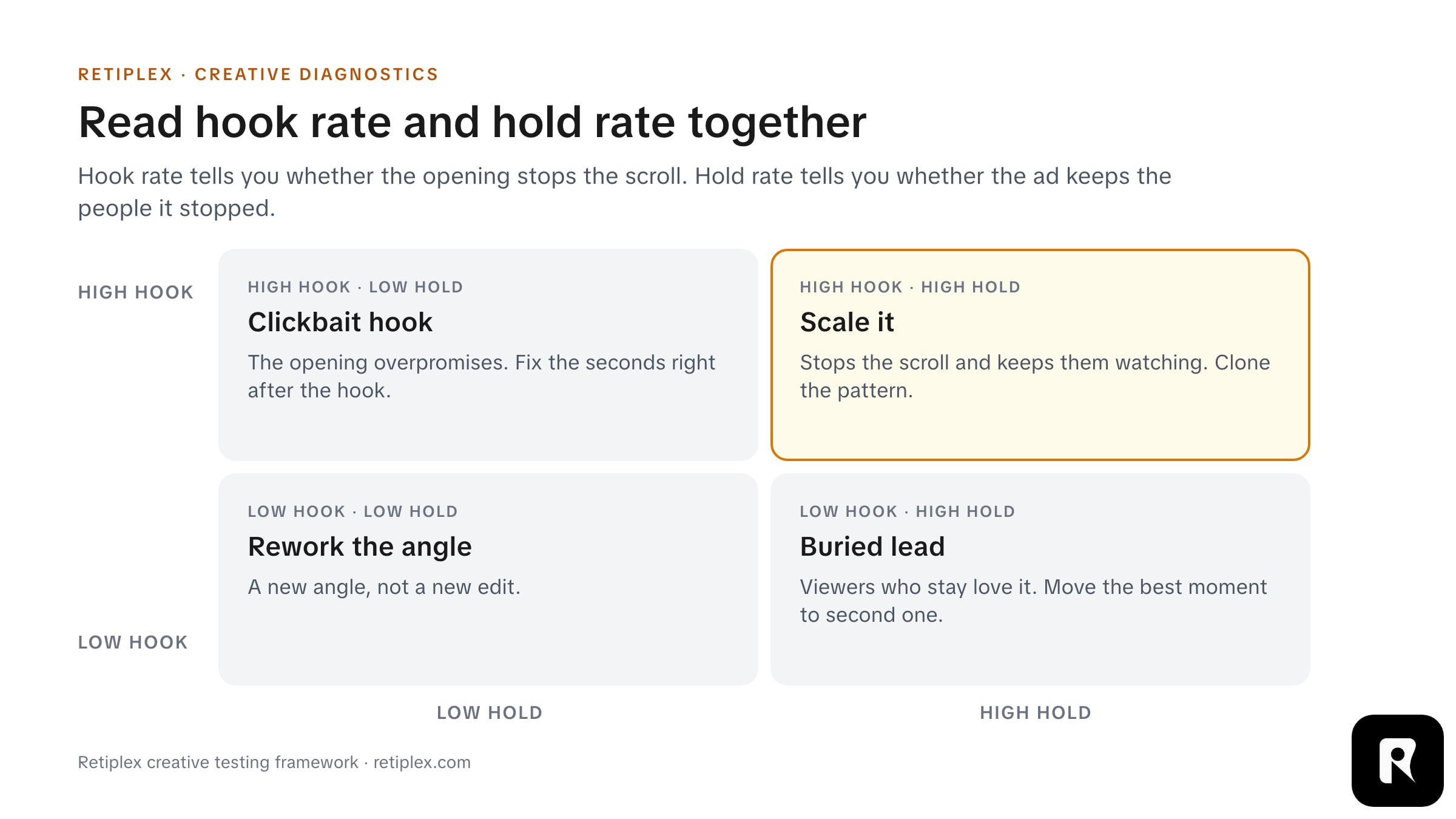
A high hook rate can be clickbait: a shock opening that stops the scroll and loses everyone a second later. So read it with hold rate (usually ThruPlays ÷ 3-second plays). We tracked the stricter version: 24.5% of people who stopped watched to the last frame, and 8% of them clicked. A dishonest hook doesn't earn either.
How to Improve Hook Rate: 6 Lessons
- Open with the problem, in your customer's words. First person, physical, in their language. For more openings, see our 47 viral hook ideas.
- Answer every pain you raise, with numbers. “Five seconds” is a claim a viewer can picture. “Quick and easy” is not.
- Read hook rate early, at low frequency. Under 1.5 you are measuring the hook. Past 2–3 you are measuring fatigue.
- Never judge hook rate alone. Pair it with hold rate and CTR, as in the matrix above.
- Test hooks, not whole ads. Keep the body and CTA fixed and swap the first three seconds. Hook rate settles within a few thousand impressions, long before purchases do. At an hour per ad, three variants is an afternoon.
- Plan for fatigue. Set a refresh trigger up front, for example when the 3-day hook rate drops 20% below launch week.
Free Viral Hook Generator
Lesson 5 in practice: get 5 hooks for your product built on different patterns, ready to test on the same ad body.
Try it free →AI Video Ads for Ecommerce: What This Case Shows
One creative, one product, one market, and a small store's sales volume, so treat 5.5x as a strong early signal, not a guarantee. What it does show: an AI-generated ad can beat the top hook-rate benchmark on cold traffic for a niche, considered product and turn that into profitable sales. Viewers judge the first three seconds, not how the video was made.
The bigger advantage is speed. At about an hour per ad, testing new hooks every week is realistic for a small team. Tools like Retiplex fully automate video ad production with AI: script, AI actor, voiceover, product shots and editing, from product photos to a finished vertical ad. For the cost side, see our AI vs traditional video ad ROI analysis.
Run your own hook-rate test this week
Upload your product photos and Retiplex builds the video ad: angle, script, AI actor, voiceover and product shots. Make three hook variations and read the hook rate within days.
Get your first video freeIncludes 1 free video and 150 credits. No credit card required.
Hook Rate FAQ
What is a good hook rate for Facebook ads?
25–30% is good, 30–45% is strong and 45%+ is exceptional. Below 20%, the opening isn't stopping the scroll. Compare within the same placement and audience temperature: Reels and warm audiences usually score higher.
How do you calculate hook rate in Meta Ads Manager?
3-second video plays ÷ impressions × 100. Meta doesn't show it by default, so add it once as a custom metric (Columns → Customize columns → Create custom metric).
Is hook rate the same as thumbstop ratio?
Yes. Hook rate, thumbstop ratio and 3-second view rate are the same Meta metric: 3-second video plays ÷ impressions.
What is a good hold rate for Facebook video ads?
Hold rate is usually ThruPlays ÷ 3-second plays. Most guides treat 40–50% as average and 60%+ as strong, but it depends heavily on video length, so compare videos of similar length.
What is a good ROAS for Facebook ads?
One comfortably above your break-even ROAS, which is 1 ÷ gross margin: 2.5x at a 40% margin, 3.3x at 30%. The SpaServis campaign's 5.5x is profitable at any margin above 18%.
What should the first 3 seconds of a video ad say?
A problem your buyer already feels, in their own words, before any product. The SpaServis ad opened with 'I was so fed up with opening the hot tub…' and hit a 55.1% hook rate.
How long does it take to make a video ad with AI?
The SpaServis ad took about an hour in Retiplex, revisions and polishing included, because Retiplex automates the whole production with AI: script, AI actor, voiceover, product shots and editing. That speed is what makes testing several hooks a week realistic.
About the data: Ad metrics come from SpaServis's Meta Ads Manager export, sales from the orders attributed to the campaign. We show rates only, without spend, revenue or dates. The charts are free to use with credit and a link to this page.