
Why TikTok Scripts Matter
There is a persistent myth that the best TikTok videos are spontaneous — just someone hitting record and riffing off the top of their head. And sure, the finished product should feel spontaneous. But behind almost every viral clip is a carefully considered script, even if that script is just three bullet points on a sticky note.
The numbers tell the story. Internal TikTok data suggests that roughly 68% of viewers decide whether to keep watching within the first two seconds. Two seconds. That is barely enough time to say a full sentence, which means every single word in your opening has to earn its spot.
Creators who script their content — even loosely — consistently outperform those who freestyle. Not because scripts make videos robotic, but because they eliminate dead air, tighten pacing, and guarantee the hook lands the way it's supposed to. Improvising is fun. Improvising with structure is what gets views.
Key takeaway: A TikTok script is not a word-for-word teleprompter read. It is a blueprint for pacing, emotion, and information flow. The best scripts feel unscripted because the structure is invisible to the viewer.
The 3-Part TikTok Script Structure
Every high-performing TikTok video — from comedy skits to product reviews to educational content — follows the same underlying arc: Hook, Body, CTA. The timing shifts depending on video length, but the sequence is universal. Let's break each section down.
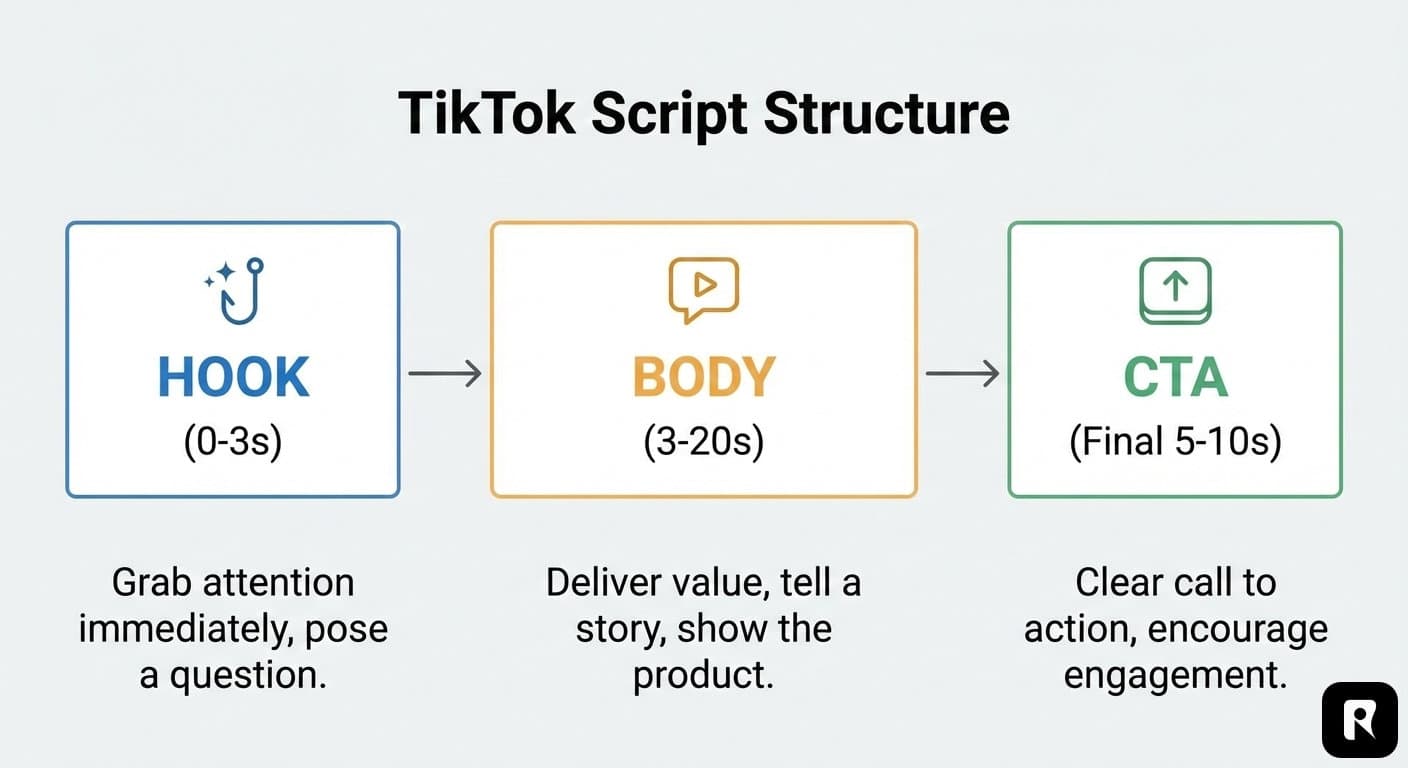
Part 1 — The Hook (0-3 seconds)
The hook is the gatekeeper. If it does not land, nothing else in your video matters because nobody will be around to see it. TikTok's algorithm weighs early retention heavily, so a strong opening doesn't just keep humans watching — it signals to the platform that your video deserves more distribution.
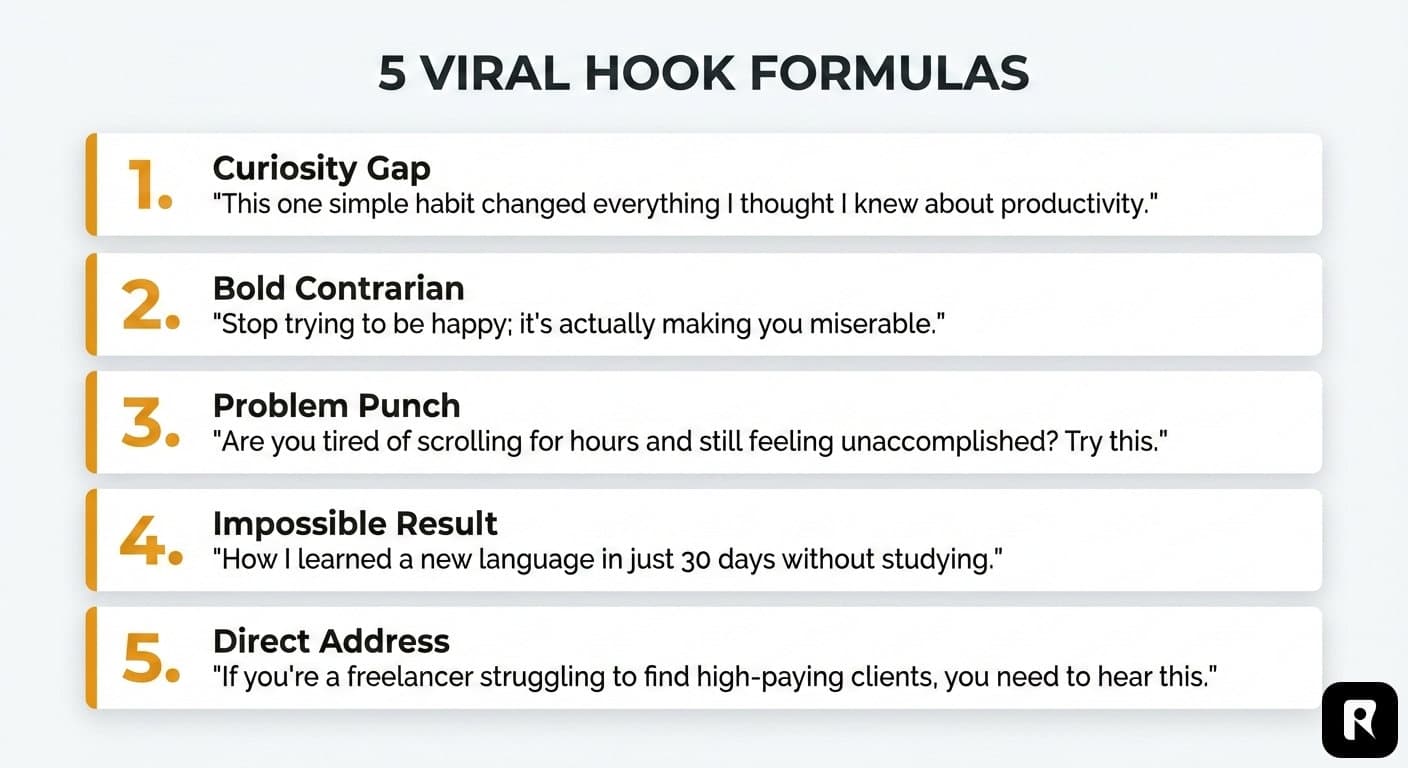
Here are five hook formulas that consistently drive retention:
- The Curiosity Gap: Open with a claim that is incomplete. "There's a reason no one talks about this skincare ingredient." The viewer stays because they need the missing piece.
- The Bold Contrarian: Challenge a popular belief. "Everything you've been told about morning routines is wrong." Disagreement is a powerful retention lever — people stick around to see if you back it up.
- The Problem Punch: Name a specific, painful frustration. "You know that feeling when you spend $200 on ads and get zero sales?" The viewer nods and keeps watching.
- The Impossible Result: Lead with an outcome that sounds too good. "I grew from 300 to 50,000 followers in 28 days. Here's the exact strategy." Specificity makes it credible.
- The Direct Address: Call out a specific audience. "Small business owners: stop making this mistake with your pricing." When viewers feel personally targeted, they pay attention.
Pro tip: Write 5-10 hook variations for every video, then pick the strongest. The hook is worth more revision time than the rest of the script combined. If you want to pressure-test your hooks quickly, try generating a few for free to see how different patterns compare.
Free TikTok Script Generator
Done learning the formulas? Generate a full 30-second TikTok script with 3 hook variations for your product.
Try it free →Part 2 — The Body (3-20 seconds)
The body is where you deliver on the promise your hook made. This is the substance — the steps, the story, the evidence, the demonstration. But substance alone is not enough. You need to deliver it at the right pace.
The golden rule of TikTok pacing: one idea per sentence. Short-form video is not the place for compound thoughts or multi-clause explanations. Each sentence should advance the narrative by exactly one step. If you can cut a word without losing meaning, cut it.
Retention also depends on how your audio and visuals work together. Here are some guidelines:
- Change the visual every 2-3 seconds. This can be a cut, a zoom, a text overlay, or a hand gesture. Anything that gives the eye something new to process.
- Match your tone to the content. If you are sharing something surprising, your voice should sound surprised. Flat delivery kills retention regardless of how good the script is.
- Use on-screen text to reinforce key points. Many viewers watch without sound. Captions and text overlays are not optional — they are a primary content layer.
- Build toward a micro-climax. The body should have its own small peak of interest around the 60-70% mark. Think of it as a "second hook" that prevents mid-video drop-off.
Pacing exercise: Read your script out loud and time it. A 30-second TikTok should have roughly 75-85 words. If your script is over 90 words, cut until it breathes. Viewers should never feel rushed or bored.
Part 3 — The CTA (20-30 seconds)
The call-to-action is where your video converts attention into action. But "convert" does not always mean "buy." On TikTok, your CTA might be a follow, a save, a comment, a share, or a click to your profile link. The right CTA depends on your goal for that specific video.
There are two types of CTAs, and the best scripts are intentional about which one they use:
- Soft CTA (engagement-focused): These invite interaction without asking for a commitment. Examples: "Follow for part two," "Save this for later," "Comment your biggest struggle with [topic]." Soft CTAs work well for top-of-funnel content where your goal is reach and algorithmic favor.
- Hard CTA (conversion-focused): These ask for a specific action. Examples: "Link in bio to grab the free template," "DM me 'STRATEGY' to get started," "Tap the product tag to shop." Hard CTAs work best when you have already built trust through previous content.
A common mistake is stacking multiple CTAs. "Follow, like, share, comment, and check the link in my bio" sounds desperate and dilutes everything. Pick one action per video and commit to it.
5 TikTok Script Templates You Can Steal
These five TikTok video script templates cover the most common content formats on the platform. Adapt the framework to your niche, swap in your own details, and you have a video-ready script in minutes.
1. Problem → Solution → CTA
Hook: "If you're still [doing common mistake], you're leaving [result] on the table."
Body: Explain the problem in 1-2 sentences. Introduce the fix. Show one specific example or result.
CTA: "Follow for more [niche] tips" or "Link in bio for the full breakdown."
This is the workhorse template. It works for product demos, educational content, service promotions, and just about anything else. The reason it works: naming a problem earns trust, solving it earns attention, and the CTA earns action.
2. Hot Take → Evidence → Reframe
Hook: "Unpopular opinion: [controversial statement about your niche]."
Body: Back up your take with a specific data point, personal experience, or example. Then reframe what the viewer should do differently.
CTA: "Agree or disagree? Drop your take in the comments."
Hot take content is comment bait by design. The algorithm loves comments because they signal high engagement, so this template tends to get disproportionate reach. The key is that your take needs to be genuinely defensible — contrarian for the sake of it backfires quickly.
3. Story Hook → Tension → Resolution
Hook: "Last week something happened that completely changed how I think about [topic]."
Body: Tell the story with rising tension. What went wrong? What was at stake? Build to the turning point.
CTA: "Has this ever happened to you? Save this so you know what to do."
Story-driven scripts have the highest average watch time because narrative tension is psychologically hard to abandon. The human brain needs resolution. Use this when you have a genuine anecdote that illustrates a broader lesson.
4. Before/After Transformation
Hook: Visual or verbal "before" state — the mess, the struggle, the starting point.
Body: Quick transition (often a jump cut synced to a beat drop). Show the "after" state in all its glory.
CTA: "Want the step-by-step? Follow for the full tutorial."
This template is visual-first and works best for physical transformations, workspace makeovers, design work, cooking, and anything where the contrast between states is dramatic. The script itself can be minimal — the visuals do the heavy lifting.
5. POV / Relatability
Hook: "POV: you just [relatable situation that your audience lives daily]."
Body: Act out or narrate the scenario with enough specificity that the viewer thinks "that's literally me."
CTA: "Tag someone who does this" or simply let the relatability drive shares organically.
POV content is the most shareable format on TikTok because sharing is how people say "this is so me." The script writing challenge here is specificity — generic scenarios ("POV: you're tired") fall flat, while precise ones ("POV: you're rewriting the same email for the fourth time because the tone isn't right") go viral.
Common Mistakes That Kill Your Watch Time
Knowing what to do is only half the equation. Here are the script mistakes that tank retention, even when the content itself is good.
Starting with "Hey guys"
This is the most common opening on TikTok, and it is also the most wasteful. "Hey guys, so today I wanted to talk about..." burns your entire hook window on filler. By the time you reach the actual content, viewers have already swiped. Start with value, not a greeting. Your audience does not need to be warmed up — they need to be stopped.
Revealing Too Much Too Early
If your hook contains the full payoff, there is no reason to keep watching. "This $5 product cleared my acne in two weeks" is a fine hook. "This $5 CeraVe cleanser from Target cleared my acne in two weeks — here's how" gives away the answer in the opening. Withhold the key detail to create a reason to stay.
Weak or Missing CTA
Many creators focus on the hook and body but let the video fizzle at the end. Without a clear CTA, viewers enjoyed your content and then scroll to the next video without taking any action. Even a simple "save this for later" dramatically increases the chance your video gets bookmarked and resurfaces in the algorithm.
Ignoring Pacing
A script can have the right words and still fail because the delivery is too slow, too fast, or too monotone. Pacing issues usually come from trying to cram too much information into a short video. If your 30-second script covers five points, cut it to two or three. Depth beats breadth every time in short-form content.
Platform-Specific Tips
While the principles of TikTok script writing apply across platforms, each short-form video app has quirks worth understanding. What works on TikTok does not always translate directly to Instagram Reels or YouTube Shorts.
| Platform | Ideal Duration | Key Difference |
|---|---|---|
| TikTok | 21-34 seconds | Fastest pacing. Raw, unpolished aesthetic often outperforms polished content. Sound-on is the default. |
| Instagram Reels | 15-30 seconds | Slightly more polished aesthetic. Captions matter more (many users browse sound-off). Hashtag strategy is different. |
| YouTube Shorts | 30-58 seconds | Longer retention windows. Educational and list-based content performs well. Subscribers matter more than on TikTok. |
On TikTok, the sweet spot for most creators is between 21 and 34 seconds. Videos in this range get the strongest completion rates, which is the metric TikTok weights most heavily for distribution. Shorter videos (under 15 seconds) can work for humor or memes but leave little room for CTAs.
Instagram Reels rewards slightly more polished content and tends to favor creators who use native Instagram features (stickers, text tools, audio from the Reels library). The audience skews a bit older than TikTok, so your script tone may need to adjust accordingly.
YouTube Shorts gives you more room to breathe. The algorithm is less sensitive to the first two seconds and more focused on overall watch time and click-through from the Shorts shelf. If your content is educational, YouTube Shorts is often the best platform for it.
Cross-posting tip: Write your script for TikTok first (tightest pacing, strictest hook requirements), then expand it slightly for YouTube Shorts. It is much easier to loosen a tight script than to tighten a loose one.
Putting It All Together
TikTok script writing is a learnable skill, not an innate talent. The creators who grow fastest are the ones who treat every video as a small experiment: write the script, record it, check the analytics, and iterate. Over time, you develop an instinct for what hooks land, how fast to pace your body, and which CTA style fits your audience.
Start with the templates above, adapt them to your niche, and focus on writing 10-20 hooks before settling on one. The hook is where most videos succeed or fail, so it deserves the most attention.
Turn your script into a finished video ad
You've got the script. Now generate the video — pick an AI actor, add your product shots, and export a ready-to-run ad in minutes.
Get your first video freeIncludes 1 free video and 150 credits. No credit card required.
But the real edge comes from understanding why each element works, not just copying a formula. That understanding is what separates creators who go viral once from those who do it consistently.