
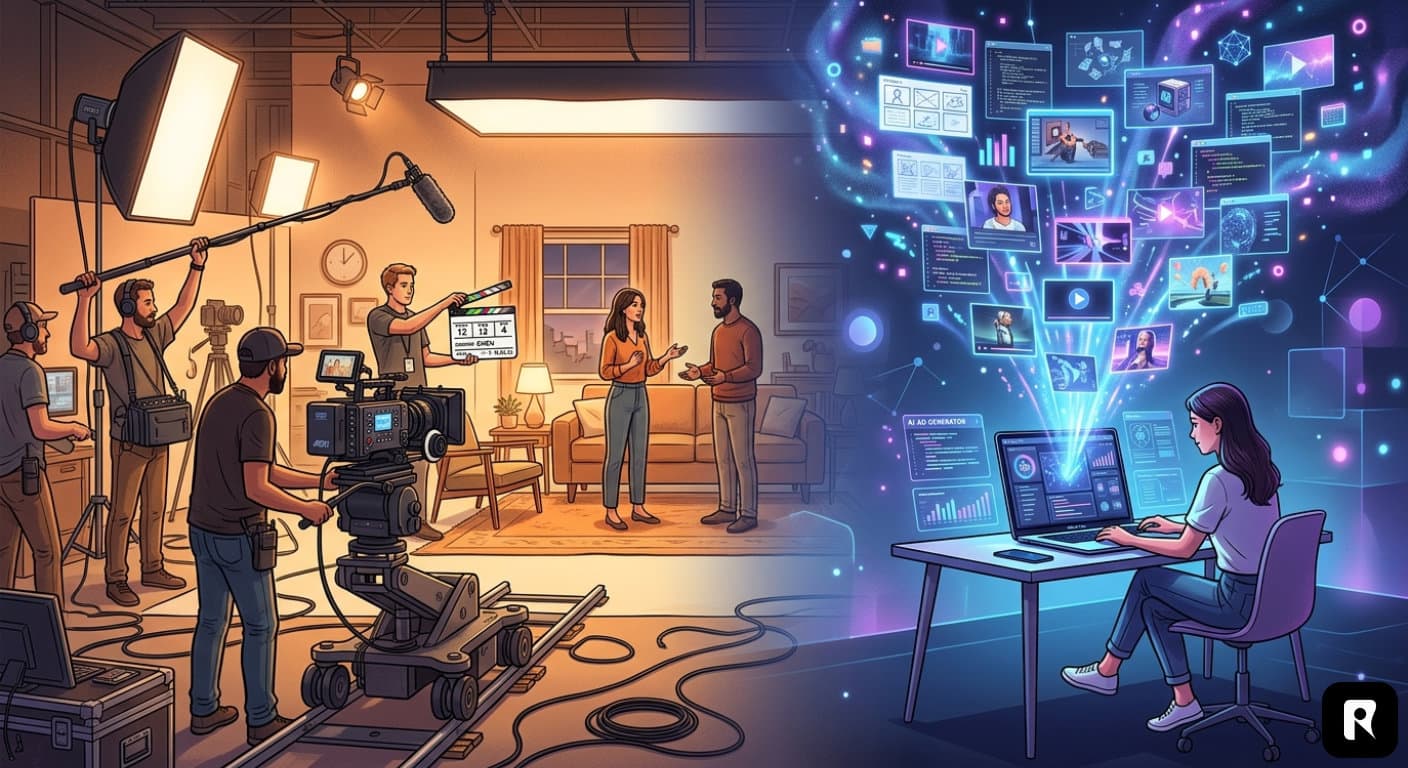
TL;DR: AI-generated video advertising is fundamentally reshaping production economics. Tools like Google Veo 3, OpenAI Sora, and Runway now enable brands to produce broadcast-quality ads for as little as $2,000 — a 95–99% reduction from traditional six- and seven-figure budgets. Time-to-market has compressed from 4–8 weeks to 2–3 days. Companies actively using AI in ad campaigns report 20–30% higher ROI, while AI-optimized creatives deliver up to 2× higher click-through rates. However, NielsenIQ neuroscience research warns that consumers are highly sensitive to perceived inauthenticity, rating obviously AI-generated ads as more annoying, boring, and confusing than traditional creative. The smartest brands are adopting hybrid strategies — using AI for volume, speed, and testing while reserving traditional production for flagship emotional storytelling.
Introduction
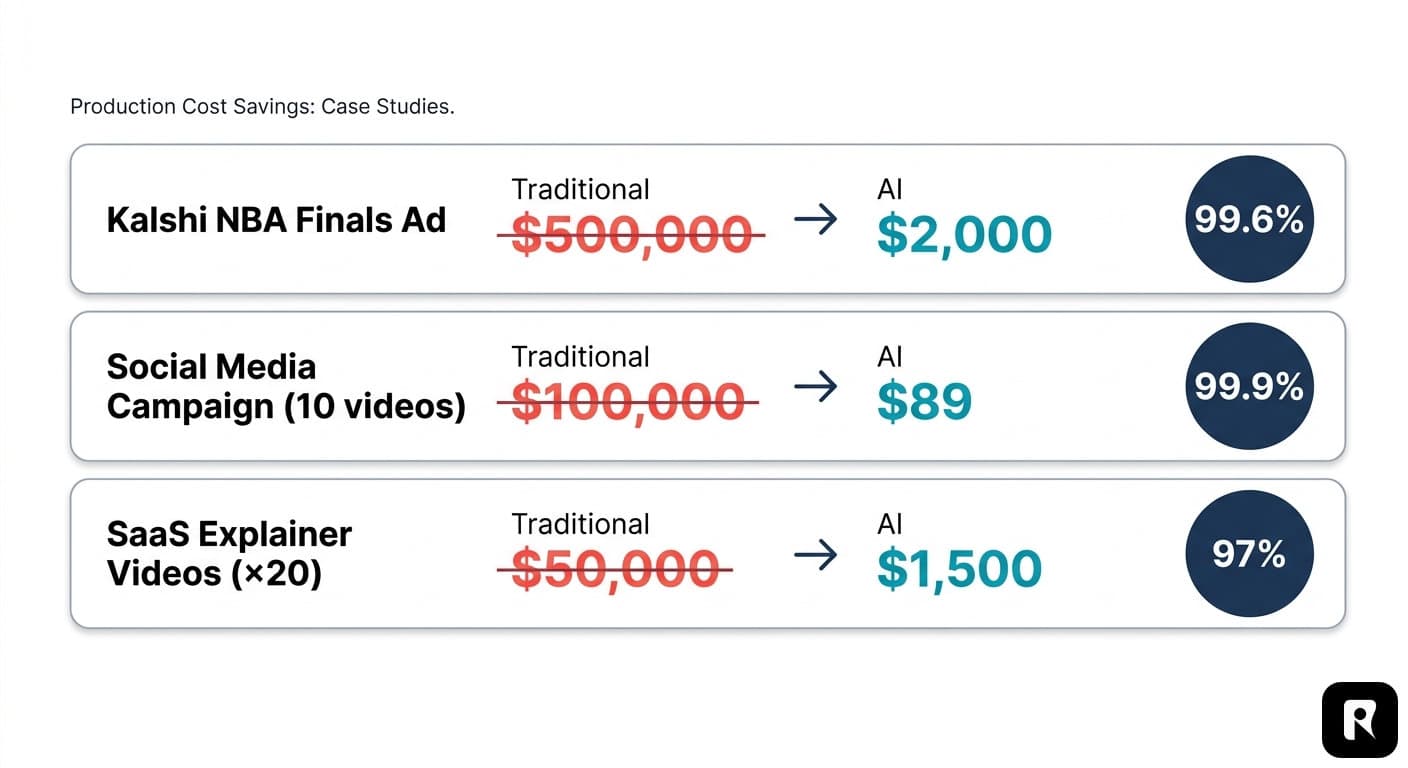
In June 2025, a single AI filmmaker named PJ Accetturo produced a 30-second commercial for prediction market platform Kalshi. It aired during Game 3 of the NBA Finals — one of the most expensive advertising time slots on American television. The cost of production? Approximately $2,000, created solo in two days using Google’s Veo 3 text-to-video model. According to Kalshi employee Tarek Mansour, a comparable commercial through traditional channels would typically cost seven figures and take months to produce (DesignRush, eWeek).
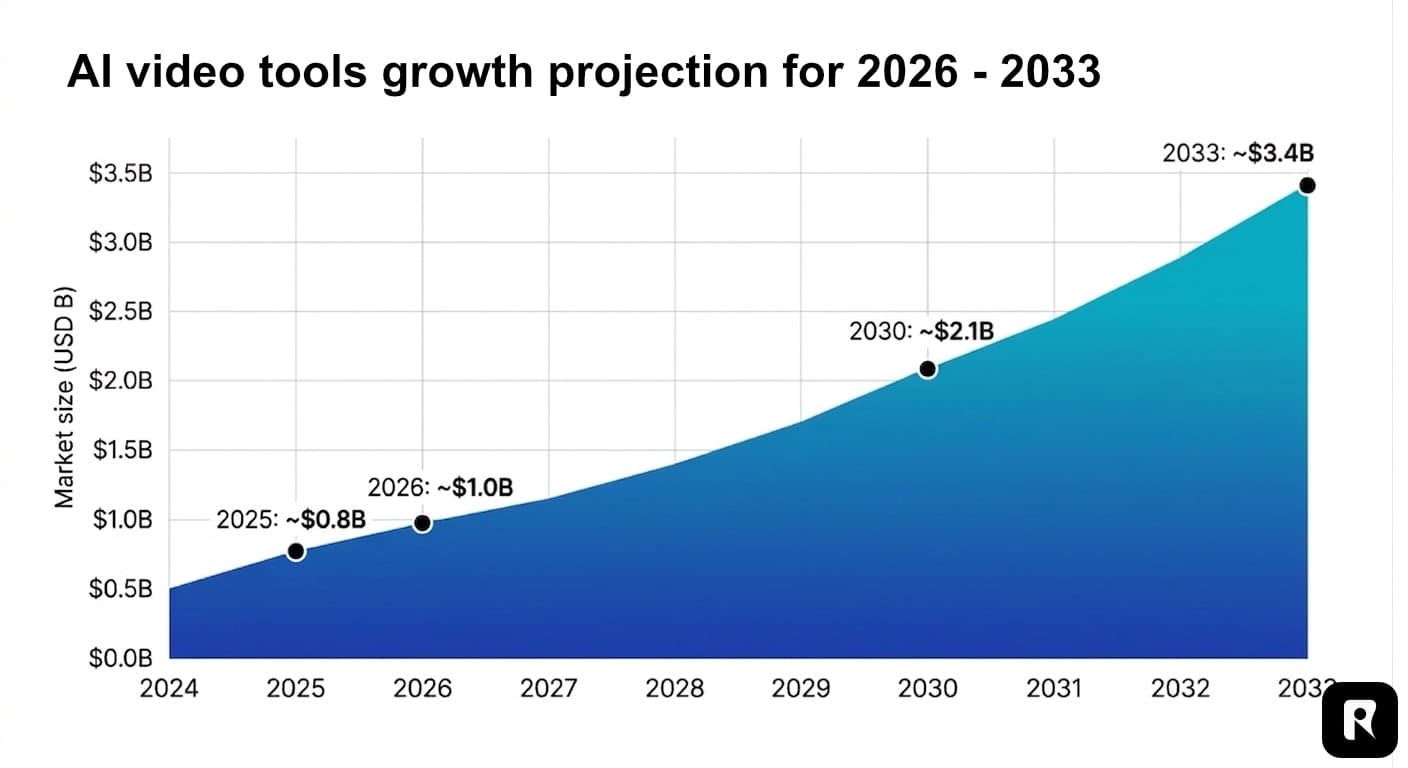
That single case encapsulates a tectonic shift in advertising economics. The AI video generator market — valued at approximately $788 million to $1 billion in 2025 — is growing at a compound annual growth rate of roughly 19–20%, with projections reaching $2–3.4 billion by the early 2030s (Grand View Research, Fortune Business Insights, Research and Markets). AI video startups have raised more than $500 million in new funding since early 2025, with Runway securing $308 million and Synthesia raising $180 million (Market.us).
This paper examines the core economic question facing every marketing team and media buyer in 2026: when does AI-generated video deliver superior return on ad spend (ROAS) compared to traditional production — and when does it fall short? We analyze production costs, time-to-market, campaign performance data, and the emerging consumer perception research to provide a framework for making that decision.
Background: The Traditional Video Production Cost Structure
To appreciate what AI disrupts, it helps to understand what it replaces. Traditional video ad production is a multi-stage, labor-intensive process with costs that accumulate across pre-production, filming, post-production, and distribution.
The Cost Landscape
Industry pricing has actually increased in recent years. As of 2025–2026, benchmark costs for traditional video production break down roughly as follows. Simple corporate videos run between $1,200 and $1,500 per finished minute, a notable increase from the $800–$1,000 range that was common before the pandemic. Complex projects involving special effects or high-profile talent can exceed $15,000 per minute, up from approximately $10,000 previously. Stock footage alone now costs $150–$400 per clip, meaning a single minute of video using multiple stock clips can reach $3,000 just for raw footage (Vidpros).
Professional agency-produced video ads typically land in the $10,000–$50,000 range for a single 60-second piece, with 4–8 weeks of production time (SuperScale). Post-production alone — editing, color grading, audio mixing, graphics — often requires 40–80 hours for a five-minute corporate video. And these figures don’t account for hidden costs: location permits ($100–$2,000/day), music licensing ($50–$1,000+ per track), and revision cycles that can inflate budgets by 10–20% (LongStories.ai).
The global video production market reached $83.55 billion in 2024 and is projected to approach $865 billion by 2033, indicating that traditional production isn’t disappearing — it’s simply being joined by a dramatically cheaper alternative (vidBoard.ai).
The AI Video Production Cost Revolution
Per-Unit Economics
AI video generation operates on fundamentally different economics. Rather than paying for crews, equipment, and studio time, brands pay for software subscriptions, compute credits, and creative iteration time.
Current pricing across the major platforms in early 2026 illustrates the range. Entry-level plans from tools like Pika ($8/month) and Runway Standard ($12/month) remove watermarks and provide enough credits for roughly 10–30 standard videos per month. The mid-tier sweet spot for active creators sits at $20–$37/month: ChatGPT Plus at $20/month includes Sora 2 with approximately 12 videos at 720p, while Kling AI Pro at $37/month delivers roughly 50 videos monthly. Professional tiers include Runway Pro at $76/month and HeyGen Business at $149/month, while ChatGPT Pro at $200/month unlocks heavy Sora 2 usage (LaoZhang AI Blog).
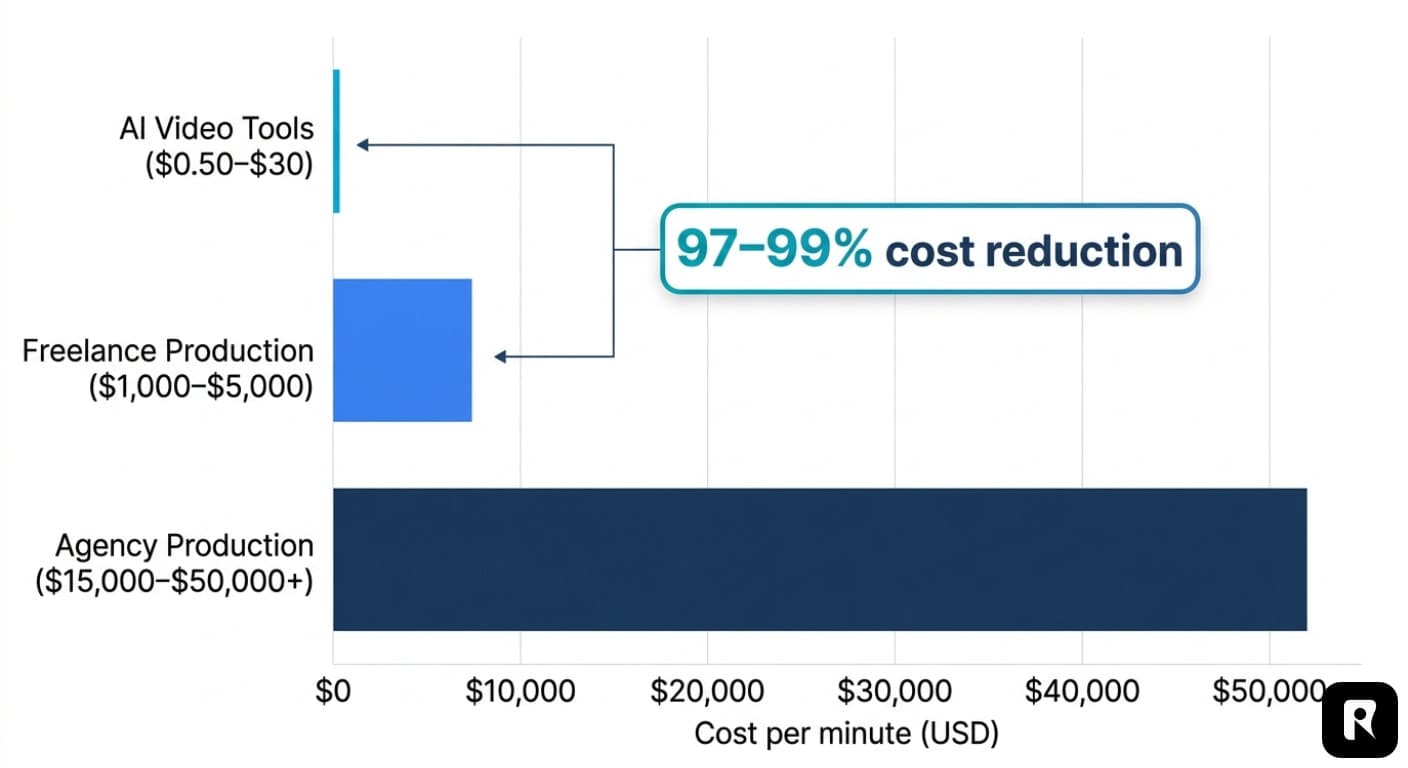
Translated into per-minute costs, AI generation ranges from approximately $0.50 to $30 per minute depending on the platform and quality level. Compare this to traditional freelance production at $1,000–$5,000 per minute, or agency work starting at $15,000 and reaching beyond $50,000 per minute for complex campaigns. The math suggests AI tools can reduce costs by 97–99% for straightforward projects (vidBoard.ai, LTX Studio).
To illustrate concretely: a 10-video social media campaign might cost as little as $89 with a platform like Synthesia, versus $100,000 or more through a traditional agency. One SaaS company reportedly produced 20 explainer videos for $1,500 total — a project that would have cost $40,000–$60,000 through traditional channels (LongStories.ai).
Tool Landscape and Specialization
The AI video ecosystem has matured into distinct categories, each serving different use cases. Avatar-based platforms like Synthesia and HeyGen specialize in talking-head presenter videos with realistic lip-sync in 140+ languages — ideal for training, demos, and personalized marketing. Their pricing reflects commercial licensing needs, with Synthesia’s Starter plans including API access and up to 360 minutes of video per year. HeyGen’s Creator plan starts at $29/month for unlimited videos up to 30 minutes at 1080p (Boss Publishing).
Generative models like Runway Gen-4, OpenAI Sora 2, and Google Veo 3.1 create entirely new visuals from text prompts — drone shots of cityscapes, product floating in space, surreal narrative sequences. Runway’s Gen-4.5 offers granular camera control favored by filmmakers, while Veo 3.1 provides up to 60-second clips with integrated audio and lip-sync capabilities. Kling AI from ByteDance has emerged as a strong budget option, offering 2-minute video generations at $10/month with impressive motion physics (Manus).
Each tool category maps to different ad formats: avatar platforms for UGC-style testimonials and explainer ads, generative models for cinematic brand spots and social content, and AI editing suites for repurposing existing footage at scale. Tools like Retiplex take this a step further by combining AI actors, automatic script writing, and seamless product integration into a single workflow — going from a product URL to a finished video ad in minutes.
Time-to-Market: From Weeks to Hours
The Speed Differential
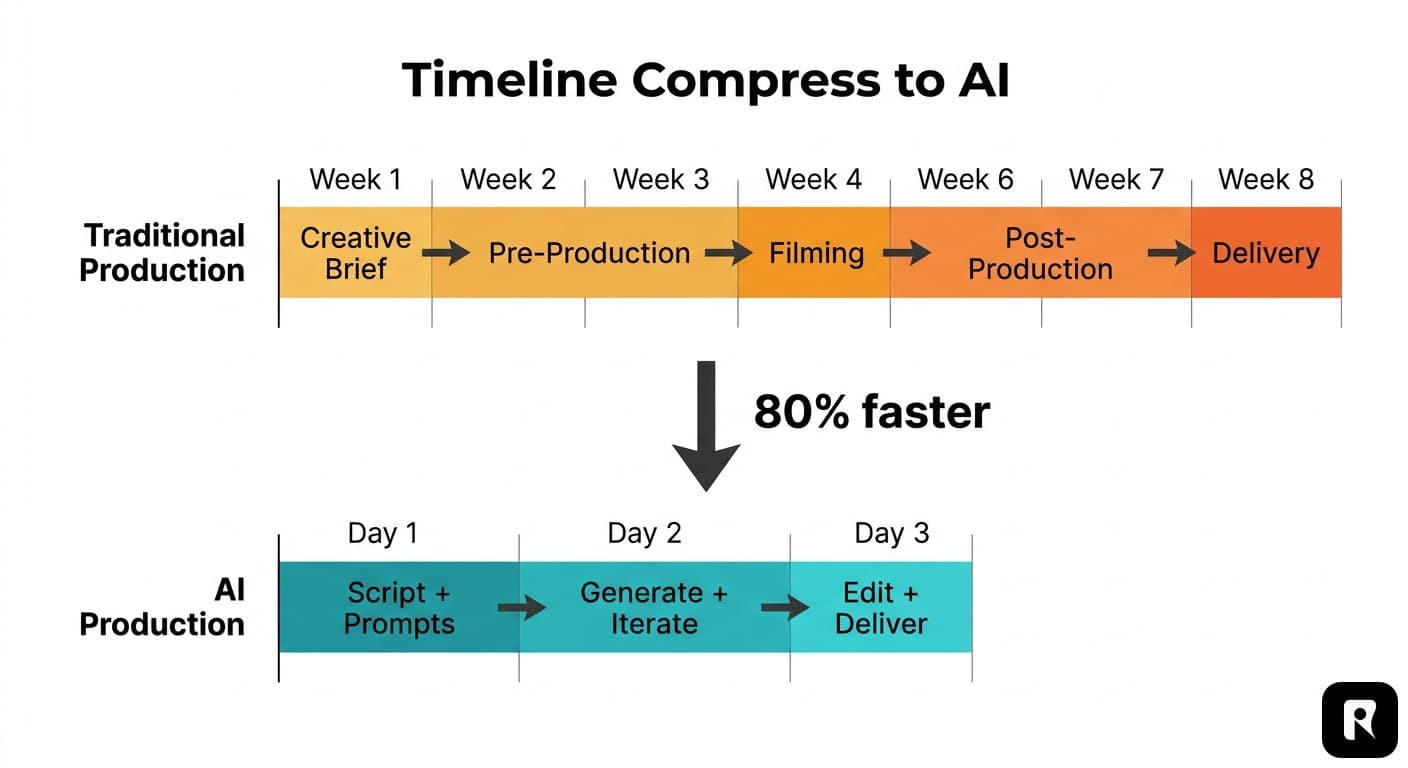
Speed is arguably an even more transformative advantage than cost reduction. Traditional video production follows a sequential, calendar-driven process: creative brief and scripting (1–2 weeks), pre-production logistics (1–2 weeks), filming (1–3 days), and post-production editing (2–4 weeks). The total timeline for a professional agency video routinely spans 4–8 weeks.
AI compresses this entire pipeline into hours or days. Industry data suggests AI tools reduce video production timelines by approximately 80%, turning what took weeks into what now takes hours (vidBoard.ai). The Kalshi NBA Finals ad took a single creator two days to concept, generate, and edit. Clients using Synthesia report updating multilingual training videos in hours rather than weeks.
Consider a practical scenario highlighted by TrueFan: an e-commerce brand wanting to launch a product ad in 10 different Indian regional languages. The traditional approach requires hiring 10 voice actors, booking studio time for each, and having editors sync new audio tracks to the original video — a process taking 3–4 weeks. The AI approach: upload one script, use the platform’s translation feature to generate 9 variants, select an avatar, and produce all 10 videos simultaneously — in under 30 minutes (TrueFan).
Why Speed Compounds ROI
This speed advantage isn’t merely a convenience — it fundamentally changes how marketing teams operate. Faster production enables more A/B testing, since generating dozens or hundreds of creative variations for testing becomes trivial when each iteration costs a few dollars rather than thousands. It allows real-time trend response, where brands can react to cultural moments, viral trends, or competitive moves within hours. And it supports continuous creative refresh, combating ad fatigue that typically degrades performance after 1–2 weeks.
The Kalshi case demonstrates this perfectly: the brand was able to save massively on production and redirect budget toward media buying and ad placement — the considerably larger expense that directly drives reach.
Return on Ad Spend: What the Performance Data Shows
The ROI Uplift
Multiple data sources point to meaningful ROI improvements when AI is integrated into advertising workflows. Companies actively using AI in marketing campaigns see between 20% and 30% higher ROI, a finding that extends beyond large enterprises to smaller players as well (Amra and Elma). Some businesses have reported as much as a 50% lift in ROAS after adopting AI-generated ad creatives, while more aggressive implementations have seen up to a 72% ROAS increase (MixFlow).
On Meta platforms specifically, AI-enabled campaigns are delivering strong returns. According to AdAmigo’s 2025 research, businesses using AI-enabled creative optimization see an average return of $4.52 for every dollar spent. Meta’s own data shows Advantage+ Shopping campaigns delivering 32% lower cost-per-acquisition and 17% higher ROAS compared to manual campaign setups. On YouTube, AI-optimized campaigns showed a 17% ROAS lift in Nielsen’s 2025 Marketing Mix Modeling study analyzing 50,000+ brand campaigns (Madgicx, Virvid).
AI-optimized creatives have shown the potential to deliver up to 2× higher click-through rates compared to manually designed versions. Meta’s large-scale test using a reinforcement-learned LLM called “AdLlama” improved click-through rates by 6.7% across 640,000 ad versions — a seemingly modest gain that translates into enormous revenue impact at scale (Amra and Elma).
Where the ROI Advantage Originates
It’s worth noting that AI’s ROAS advantage stems not just from cheaper production but from three compounding effects. First, creative volume: companies save approximately $4,000 for every 10-ad set by leveraging AI generators instead of traditional methods, enabling far more variation testing (MixFlow). Second, production-to-media reallocation: when production costs drop by 90%, those freed dollars can flow into media spend — the actual driver of impressions and conversions. Third, iteration velocity: AI allows marketers to identify winning creatives and retire underperforming ones faster, reducing wasted spend.
An e-commerce brand spending $50,000 monthly on paid media can use AI to enable 10× more creative testing at roughly 10% of the traditional cost. This means finding winning messages faster while reinvesting production savings into distribution (Virvid).
Put these economics to work — create AI video ads in minutes
The ROI data is clear: AI-generated ads deliver more creative volume at a fraction of the cost. Import your product, pick an AI actor, and start testing variations today.
Get your first video freeIncludes 1 free video and 150 credits. No credit card required.
Case Studies: Real-World Results
Kalshi: The $2,000 NBA Finals Commercial
The Kalshi case has become the most widely cited example of AI video advertising economics. Prediction market platform Kalshi initially sought a traditional advertisement for the 2025 NBA Finals but turned to AI after receiving prohibitively high production quotes. Filmmaker PJ Accetturo produced the 30-second spot alone in 2–3 days using Google Veo 3, Gemini for scripting and prompt generation, and CapCut/Adobe Premiere Pro for editing. He generated 300–400 clips and extracted 15 usable ones for the final cut. Total production cost: approximately $2,000 — representing a 95% reduction from traditional methods. The ad generated over 30 million views across platforms within three weeks (MarkTechPost, Mashable via Gigazine, TheKeyword).
Cadbury “Not Just A Cadbury Ad”: AI Personalization at Scale
Mondelēz International’s Cadbury Celebrations campaign in India used AI-powered face synthesis and voice cloning (via Rephrase.ai) to create thousands of hyper-personalized video ads featuring Bollywood superstar Shah Rukh Khan — each mentioning a specific local store by name. The campaign covered 500+ pin codes and reached over 2,000 local retailers. A self-serve microsite enabled additional store owners to generate their own personalized ads. This level of personalization would have been financially impossible through traditional production, as each variation would have required separate recording sessions. The campaign won the Grand Prix at the M&M Global Awards and gold at the Clio Awards 2022 (Ogilvy, Respeecher).
Enterprise Cost Reduction Benchmarks
Several enterprises have reported concrete cost reductions from adopting AI video. Stellantis Financial Services cut video production costs by 70% using AI-generated videos for training and communication. Sonesta Hotels reduced production costs by 80% for certain internal and marketing content. In one documented case study, a company called “Modern Canada” saved up to $6,000 per video while delivering content 90% faster using Synthesia (Magic Hour).
The pet brand Whole Life Pet reportedly saved $2,900 per video produced using AI avatars — a significant figure for a mid-market brand’s marketing budget (Oreate AI).
AI-Driven E-Commerce Campaign Optimization
Turkish home goods retailer Karaca implemented an AI-driven campaign structure for Performance Max. Across May 2024 to February 2025, the approach delivered a 44% ROAS increase and 31% revenue growth through automated product prioritization and budget allocation (Influencer Marketing Hub).
Challenges and Limitations
The Consumer Perception Problem
Perhaps the most significant counterpoint to the AI video revolution comes from NielsenIQ’s neuroscience research. Their study of 2,000 consumers found that AI-generated creative was consistently rated as more “annoying,” “boring,” and “confusing” than ads produced through traditional methods. Consumers proved highly adept at spontaneously identifying AI-generated content — the only ad that escaped detection was one that had undergone considerable iterative editing by an advertising professional (NielsenIQ, Marketing Dive).
Even more concerning for brands: brain activity measurements via EEG showed that memory activation was weak in most AI-generated ads tested, even those perceived as “high quality.” This means AI ads may generate clicks but fail to build lasting brand associations — a critical distinction for long-term brand equity.
NIQ’s 2026 CMO Outlook report reinforced this finding: ads perceived as AI-generated perform less well across memory activation, word of mouth, and purchase intention. The report noted a telling nuance — AI-generated imagery can actually outperform human-generated images in click-through rates, but only when the AI content doesn’t look like AI (NIQ CMO Outlook).
The Nuremberg Institute for Market Decisions found that across the US, UK, and Germany, only about 20% of respondents trust AI itself, and only 21% trust AI companies and their promises. When consumers were informed that content was AI-generated, they rated it lower on appeal, credibility, emotional impact, and memorability (NIM).
Technical Limitations
Current AI video tools still face meaningful constraints. Runway Gen-4.5 maxes out at 16-second clips — far shorter than competitors like Veo 3.1 (60 seconds) or Kling AI (2 minutes). Most generative models produce silent footage, requiring separate audio production. Photorealism varies significantly: while top-tier models approach near-live-action quality, artifacts, inconsistent physics, and the “uncanny valley” remain common (Max-Productive).
The Kalshi ad illustrates this trade-off: Veo 3 maxed out at 720p, each clip was only eight seconds long, and Accetturo extracted only 15 usable clips from approximately 400 generation attempts — a roughly 3.75% usable rate (Mediashower).
The Authenticity vs. UGC Dynamic
There’s an emerging tension in the data around authenticity. UGC-style content consistently outperforms polished studio production across engagement metrics: visitors spend 90% more time on sites featuring UGC, and conversions increase by approximately 10%. UGC drives 4× higher click-through rates than traditional brand ads and increases conversions by 161% when featured on product pages (SuperScale).
This creates a paradox for AI video: the technology excels at producing polished, scalable content, but audiences increasingly reward content that feels raw, authentic, and human. The most effective AI video strategies may therefore be those that deliberately lean into imperfect, UGC-inspired aesthetics rather than chasing cinematic perfection.
Free UGC Script Generator
The data shows UGC-style content outperforms polished production. Generate authentic-feeling UGC ad scripts for your product with hook, story, and CTA sections ready to use.
Try it free →Regulatory and Disclosure Requirements
The regulatory landscape is tightening. New York state law (effective December 2025) requires conspicuous disclosure for AI avatar ads. California’s AB 2655 mandates disclaimers for political ad content. The EU AI Act’s Article 52 requires deepfake disclosure. TikTok auto-labels AI content and penalizes undisclosed AI with strikes. Even for non-political commercial ads, transparency is becoming a platform expectation (Virvid).
Future Outlook
The Hybrid Production Model
The data points toward a hybrid model rather than wholesale replacement. AI handles the high-volume, fast-turnaround, variation-heavy workload — social content, A/B test variants, localization, personalized outreach, and performance ads. Traditional production retains its advantage for flagship brand campaigns, authentic testimonials, physical product demonstrations, and content requiring genuine human emotion.
As one industry analysis put it: traditional production excels when human connection matters — employee interviews, customer testimonials, personal stories — because real people create stronger connections. AI excels when scale, speed, and cost-efficiency drive the decision (Magic Hour).
Emerging Capabilities
Several trends suggest the cost and quality gap will continue narrowing. Real-time video generation is on the horizon, with multiple platforms working to reduce generation times from minutes to seconds. Multi-modal AI understanding — text, image, audio, and video unified in a single model — is becoming standard. Autonomous AI video agents that handle entire production workflows from brief to finished ad are in development (ArtSmart).
Google’s Veo 3.1 now offers 1080p generation with integrated audio and enterprise-grade SynthID watermarking. ByteDance’s Seedance model is approaching Western competitors in realism at lower cost points. As model efficiency improves, generation costs will likely decrease even as quality increases — the same deflationary dynamic seen in cloud computing (Market.us).
Market Projections
As of early 2026, 88% of marketers report using AI tools on a daily basis, and the AI-in-marketing market has reached an estimated value of $47.32 billion — roughly quadruple its $12.05 billion valuation in 2020. The generative AI segment specifically is expected to grow from $2.72 billion in 2024 to approximately $7.96 billion by 2029 (MixFlow).
Key Takeaways
- The cost arbitrage is real and dramatic. AI video production costs range from $0.50–$30 per minute versus $1,000–$50,000 for traditional methods — a 97–99% reduction for many use cases. A year of AI platform subscription often costs less than a single day with a traditional film crew.
- Time-to-market is the under-appreciated advantage. Compressing production from 4–8 weeks to 2–3 days doesn’t just save time — it enables fundamentally different marketing strategies: real-time trend response, continuous creative testing, and rapid localization.
- ROAS improvements are well-documented but context-dependent. Companies report 20–50% higher ROI from AI-optimized campaigns, with some achieving 72% ROAS lifts. The gains come primarily from creative volume, faster iteration, and budget reallocation from production to media spend.
- Consumer perception is the critical counterweight. NielsenIQ research consistently shows that obviously AI-generated content triggers negative responses — lower memory activation, less emotional connection, and a “negative halo effect” on brand perception. The key insight: AI-generated imagery outperforms only when it doesn’t look like AI.
- The winning strategy is hybrid and format-specific. Use AI for high-volume performance ads, social content, localization, personalization, and A/B testing. Reserve traditional production for flagship campaigns, authentic testimonials, and emotionally complex storytelling. The Cadbury campaign demonstrates the ideal: AI enabling personalization at a scale that traditional methods could never achieve.
- UGC-style aesthetics may be AI video’s sweet spot. Since audiences reward authenticity over polish, AI tools that produce imperfect, human-feeling content may outperform those chasing cinematic perfection. TikTok’s internal research confirms that creator-led ads drive 70% higher CTR than brand-produced content.
- The democratization effect is reshaping competition. When a solo creator can produce an NBA Finals-quality commercial for $2,000, the barrier separating Fortune 500 ad budgets from startup budgets collapses. Small brands can now test creative at enterprise scale.
Sources
- Grand View Research, “AI Video Generator Market Size, Share | Industry Report 2033.” grandviewresearch.com
- Fortune Business Insights, “AI Video Generator Market Size, Share | Growth Report [2034].” fortunebusinessinsights.com
- Research and Markets, “AI Video Generator Market Report 2026.” researchandmarkets.com
- Market.us, “AI Video Market Share, Size, Growth, CAGR at 36.20%,” November 2025. market.us
- vidBoard.ai, “AI Video Generation vs. Traditional Production: Cost Breakdown,” October 2025. vidboard.ai
- LTX Studio, “What Is & How Much Does AI Video Generation Cost?,” January 2026. ltx.studio
- LongStories.ai, “AI vs. Manual Video Production: Cost Comparison.” longstories.ai
- Vidpros, “AI Video Generator Costs in 2026: Sora vs Veo 3 Pricing,” February 2026. vidpros.com
- LaoZhang AI Blog, “How Much Does an AI Video Generator Cost in 2026?,” March 2026. blog.laozhang.ai
- SuperScale, “Best AI Video Generators for Startups: 2025 Complete Guide,” January 2026. superscale.ai
- Sprello, “Cost Of AI Video Ads Production: Complete Pricing Guide,” May 2025. sprello.ai
- Magic Hour, “Video Production Costs in 2025: Traditional vs AI-Powered Solutions.” magichour.ai
- Amra and Elma, “TOP 20 AI-GENERATED AD CREATIVE PERFORMANCE STATISTICS 2025,” November 2025. amraandelma.com
- MixFlow, “Generative AI Ad Performance Report November 2025.” mixflow.ai
- Madgicx, “How AI Creative Optimization Can Improve ROAS in 2025,” September 2025. madgicx.com
- Virvid, “AI Video Ads That Convert in 2026: Complete Guide,” January 2026. virvid.ai
- AdAmigo, “Meta Ads Benchmarks 2025 by Industry.” adamigo.ai
- DesignRush, “Kalshi’s $2K NBA Finals AI Ad Shows Why Big-Budget Commercials Are Dying,” July 2025. news.designrush.com
- MarkTechPost, “AI-Generated Ad Created with Google’s Veo3 Airs During NBA Finals,” June 2025. marktechpost.com
- eWeek, “First Completely AI-Generated Ad Played During NBA Finals,” June 2025. eweek.com
- Mediashower, “Kalshi: The First Viral Ad Made by AI.” mediashower.com
- Ogilvy, “Shah Rukh Khan My Ad - Cadbury.” ogilvy.com
- Respeecher, “How Respeecher’s AI Voice Cloning Revolutionized Mondelēz’s Diwali Campaign.” respeecher.com
- NielsenIQ, “Will AI-generated advertising disrupt the creative industry?,” September 2025. nielseniq.com
- Marketing Dive, “Consumers call AI-generated video ads annoying, confusing, per NIQ,” December 2024. marketingdive.com
- NIQ, “CMO Outlook: Guide to 2026,” March 2026. nielseniq.com
- NIM (Nuremberg Institute for Market Decisions), “Consumer attitudes toward AI-generated marketing content.” nim.org
- Oreate AI, “Navigating the Landscape of Video Generation AI Pricing,” January 2026. oreateai.com
- Manus, “Top 10 Best AI Video Generators of 2026.” manus.im
- Boss Publishing, “From Sora to Veo: Ranking the 10 Top AI Video Generators for 2026,” November 2025. thebossmagazine.com
- Max-Productive, “Runway AI Review 2026: Features, Pricing & Gen-4 Video Tool,” January 2026. max-productive.ai
- TrueFan, “AI Video Production Cost vs Traditional: 2025 CFO ROI Guide.” truefan.ai
- Influencer Marketing Hub, “Proven Case Studies Showing AI in Advertising Moves the Needle,” December 2025. influencermarketinghub.com
- Pragmatic Digital, “10+ Best AI Advertising Campaigns & Case Studies,” September 2025. pragmatic.digital
- ArtSmart, “AI Video Generator Market Statistics for 2025,” January 2025. artsmart.ai
- Versaunt, “The Real Cost of Video Ad Production: How AI Slashes Expenses by 90%,” October 2025. versaunt.com
- eMarketer, “How AI rewired marketing in 2025,” December 2025. emarketer.com