
What Is a UGC Ad Script (And Why It Matters)
A UGC ad script is the written blueprint behind a user-generated content advertisement. Unlike a traditional commercial script with precise stage directions and brand-voice mandates, a UGC script reads more like a set of talking points and emotional beats designed to sound like a real person sharing a genuine recommendation.
UGC ads — short videos where everyday people (or paid creators posing as everyday people) talk about a product on camera — have become the dominant format on TikTok, Instagram Reels, and YouTube Shorts. They work because they blend into the feed. Viewers process them as peer recommendations rather than interruption advertising, which triggers a fundamentally different level of trust.
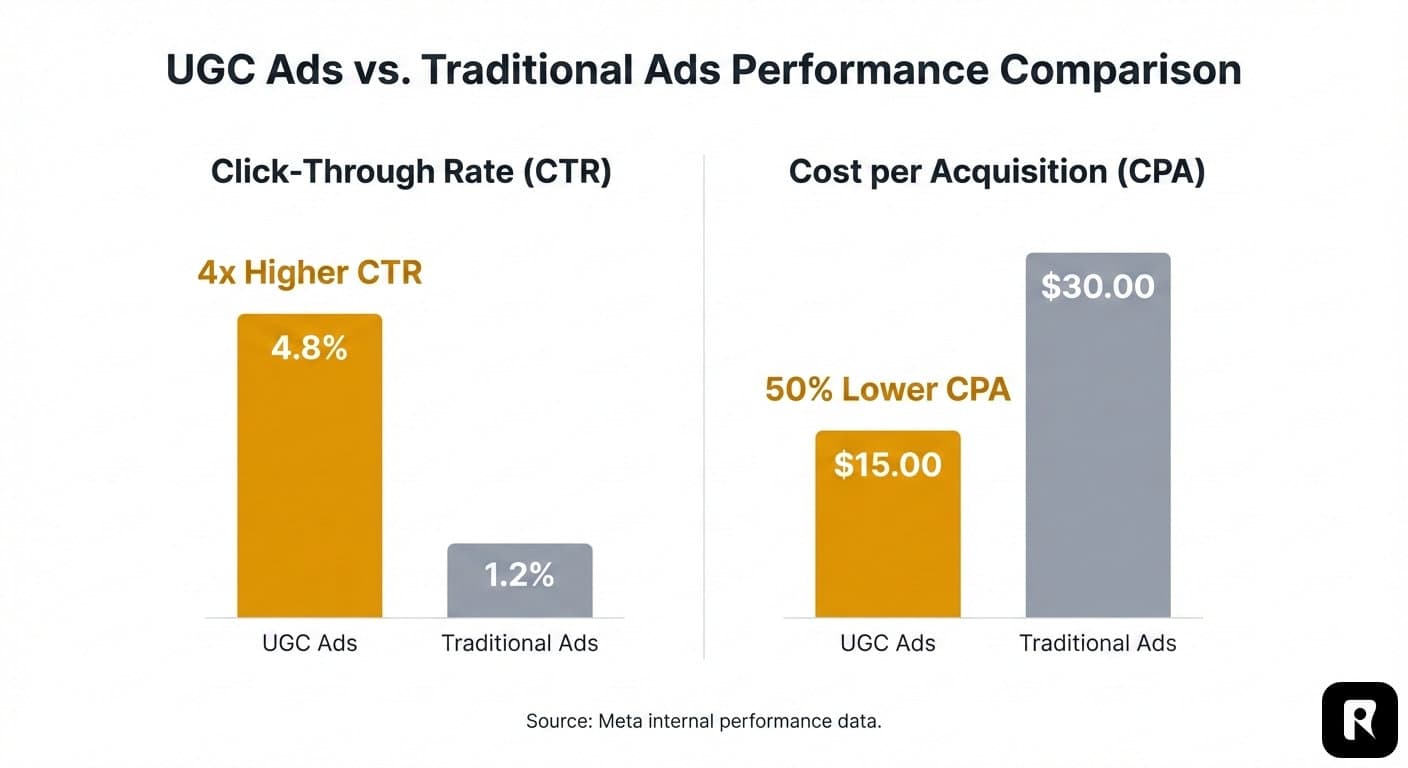
The numbers back this up. Meta's internal performance data shows UGC-style creatives achieve up to 4x higher click-through rates and roughly 50% lower cost-per-acquisition compared to polished brand-produced ads. TikTok's own research echoes this: ads that “look like TikToks” outperform traditional video ads in every engagement metric.
But “authentic” does not mean “unplanned.” The best UGC ads are carefully scripted — they just don't sound like it. This is what professional media buyers call structured spontaneity: every beat of the video is intentional, yet the delivery feels completely off-the-cuff. The script is the invisible architecture that makes this possible.
Without a script, creators ramble, forget to mention key selling points, bury the hook, or skip the call to action entirely. With a good script, even first-time creators can deliver a compelling 45-second ad on the first or second take. The script is the single highest-leverage element in the UGC production process.
The 5-Part UGC Ad Script Structure
Nearly every high-performing UGC video script follows the same underlying structure. The specifics change depending on the product, platform, and ad goal, but the framework stays constant. Here are the five sections, the time allocation for each, and how to write them.
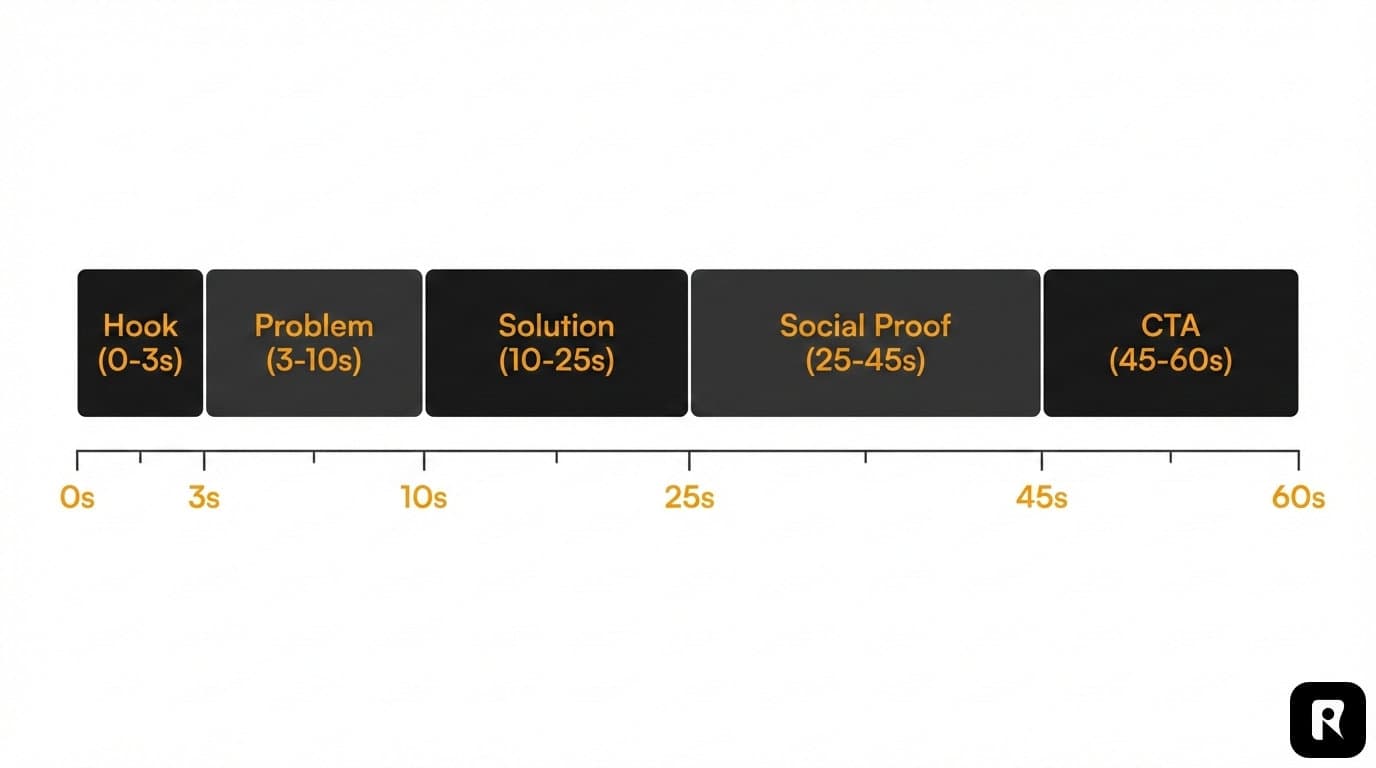
1. The Hook (0–3 seconds)
The hook is the single most important part of your UGC ad script. On platforms where users scroll at speed, you have roughly three seconds to earn the next thirty. If the hook fails, the rest of the script is irrelevant.
Effective hooks work by creating a pattern interrupt — they break the viewer out of autopilot scrolling by triggering curiosity, recognition, or emotional resonance. The three most reliable hook categories are:
- Curiosity gap: “I found the one thing that actually fixed my [problem]” — teases a payoff without revealing it.
- Bold claim / hot take: “Stop wasting money on [common solution]” — challenges the viewer's current behavior.
- Relatable moment: “POV: you've tried literally everything for [problem]” — mirrors the viewer's lived experience.
Pro tip: Write at least five hooks for every script and test them as separate ad variations. The hook alone accounts for 80%+ of the performance difference between winning and losing creatives. For more hook inspiration, check out our collection of 47 viral hook ideas for TikTok and Instagram Reels.
2. The Problem (3–10 seconds)
Once you have their attention, agitate the pain point. This section exists to make the viewer feel seen — to describe their frustration so precisely that they think, “this person gets exactly what I'm dealing with.”
The key is specificity. “I was so tired of breakouts” is weak. “I was spending $200 a month on serums that did absolutely nothing, and every morning I still had to cake on concealer before leaving the house” is vivid and personal. Use first-person language, mention failed alternatives the viewer has probably tried, and describe the emotional weight of the problem — not just the functional one.
This section is also where you establish relatability. The creator should feel like a peer, not a spokesperson. Phrases like “I know this sounds dramatic but...” or “okay so I was literally about to give up on this...” add the casual texture that makes UGC feel real.
3. The Solution (10–25 seconds)
Now introduce the product — but do it the way someone would in a real conversation, not like a commercial. The golden rule: show, don't tell. Instead of listing feature specs, describe the experience of using the product and the moment you realized it was different.
Phrases that work well for natural product introductions:
- “Then my friend told me about [product]...”
- “I saw this ad (ironically) and figured I'd try it...”
- “So I was scrolling TikTok and kept seeing [product] everywhere...”
The solution section is also where you show the product in action. In a UGC video script, include scene directions like “[show product close-up]” or “[demonstrate applying/using]” to guide the creator. Visual proof of the product being used in a real setting reinforces the authenticity of the entire ad.
Focus on two to three key benefits, not features. “The battery lasts 14 hours” is a feature. “I can take it on a full day trip without worrying about charging” is a benefit that maps to the viewer's life.
4. Social Proof (25–45 seconds)
Social proof is the credibility engine of your UGC ad script. This section answers the unspoken question every viewer has: “Why should I believe you?”
Effective social proof in UGC comes in several forms:
- Personal results: “After two weeks, I noticed [specific change]” — concrete, time-bound outcomes beat vague praise every time.
- Before/after contrast: “I used to [old way] but now [new way]” — transformation narratives are inherently compelling.
- Third-party validation: “My roommate/partner/friend asked me what I was using” — external reactions serve as an implicit endorsement.
- Scale signals: “It's got 10,000+ five-star reviews” or “over a million units sold” — numbers create a bandwagon effect.
Pro tip: The most persuasive social proof combines a personal result with a time frame. “In three weeks my skin completely cleared up” is dramatically more convincing than “it really works.” Specificity is the currency of trust.
5. The CTA (45–60 seconds)
The call to action is where your UGC video script earns its return. Without a clear CTA, even a compelling video is just entertainment — it won't drive the action your ad spend is optimizing for.
Match the CTA tone and intensity to your ad objective:
- Awareness goal: Soft CTA — “Check them out, seriously” or “Link in bio if you want to look into it.”
- Conversion / purchase goal: Direct CTA with urgency — “Use my code SAVE20 before it expires” or “They're running a sale right now, link is below.”
- App download goal: Friction-reducing CTA — “It's free to download, literally takes 10 seconds” or “I'll leave the link — just try it.”
Urgency helps, but keep it authentic. “This deal ends tonight!” delivered in a panicked voice feels like an infomercial. “Honestly not sure how long this price is gonna last” feels like a friend giving you a heads-up. The tone should match the rest of the script.
UGC Script Examples by Ad Goal
Theory only gets you so far. Below are three complete UGC script templates you can adapt for your own product. Each one uses the five-part structure above, adjusted for a different advertising objective.
Brand Awareness Script Example
This UGC script template is designed for top-of-funnel campaigns where the goal is reach and recall, not immediate purchase. The tone is casual, the CTA is soft, and the focus is on making the brand memorable.
Conversion / Sales Script Example
This UGC video script is built for direct-response campaigns where every view needs to push toward a purchase. The hook is more aggressive, the social proof includes a specific number, and the CTA includes urgency and a discount code.
App Download Script Example
For app download campaigns, the script needs to minimize perceived effort. The hook creates curiosity, the demo is visual, and the CTA emphasizes that downloading is free and fast.
Platform-Specific UGC Script Tips
The five-part structure works everywhere, but each platform has its own culture and pacing expectations. A UGC script that crushes on TikTok might feel off on Facebook. Here is how to adjust your writing for each major channel.
TikTok
TikTok rewards chaotic energy and native feel. Scripts should feel like a random person grabbed their phone and started talking. Use jump cuts, mid-sentence hooks (“wait, I need to tell you something”), and informal language. Avoid anything that sounds remotely rehearsed. The hook needs to hit within the first 1–2 seconds — TikTok users scroll faster than any other platform. For a deeper dive into TikTok-specific scripting, see our guide on how to write a TikTok script that goes viral.
Instagram Reels
Reels audiences tolerate slightly more polish. The aesthetic bar is higher — better lighting, smoother transitions — but the script still needs to feel conversational, not corporate. Instagram users also tend to watch with sound off more frequently, so pair your script with on-screen text that captures the key message. Write your hook with visual cues in mind, not just spoken words.
YouTube Shorts
YouTube audiences are accustomed to longer content, so Shorts can take a slightly more deliberate setup. You can spend an extra two to three seconds on context before revealing the product. YouTube Shorts also re-loop automatically, so consider writing a hook that connects to the end of the video — creating a satisfying loop that encourages repeat views and signals the algorithm.
Facebook / Meta
Facebook reaches a wider, older demographic. UGC scripts for Facebook generally need a bit more context — you cannot assume the viewer knows TikTok slang or trending audio references. The problem section can be slightly longer and more detailed. Direct, clear CTAs (“click the link below to order”) outperform subtle ones on this platform. Keep in mind that Facebook also surfaces ads heavily in the feed alongside friends and family content, so the “real person” feel is especially important here.
7 UGC Script Mistakes That Tank Performance
Even experienced media buyers fall into these traps. If your UGC ads are underperforming, check the script for these common issues before blaming the creative or the targeting.
- Sounding too scripted or salesy. If a viewer can tell the creator is reading from a script, the entire premise of UGC collapses. Write the way people actually talk — sentence fragments, filler words, casual phrasing. Read the script aloud. If it sounds like ad copy, rewrite it.
- No hook or a weak hook. Starting with “Hey guys!” or “So I wanted to share this product” is an instant scroll-past. The first sentence needs to create tension, curiosity, or emotional recognition. Never ease into a UGC ad — hit hard immediately.
- Listing features instead of benefits. “It has 5000mAh battery capacity, USB-C charging, and Bluetooth 5.3” tells the viewer nothing about their life. “I took it on a weekend camping trip and still had battery left when I got home” tells a story they can see themselves in.
- Missing the CTA entirely. You would be surprised how many UGC scripts end with “yeah so that's it, I really like it!” without ever telling the viewer what to do next. Even a soft CTA is better than no CTA.
- Wrong tone for the platform. A script written for TikTok's chaotic energy will feel bizarre on Facebook. A polished Instagram Reels script will feel stuffy on TikTok. Always write (or at least adapt) for the specific platform you are running on.
- Too long without visual variation. If the creator is talking to camera for 45 seconds straight with zero visual change, viewers will drop off no matter how good the script is. Build in scene direction cues like “[cut to product close-up]” or “[show screen recording]” every 5–8 seconds.
- Not matching the creator's natural voice. A script written in millennial slang will sound forced coming from a 45-year-old mom creator, and vice versa. The best UGC ad scripts are written for a specific creator persona, or at least include flexibility notes so the creator can adapt the wording to their natural speech patterns.
Quick check: Record yourself reading your script aloud as if you were telling a friend about the product over coffee. If you cringe at any line, rewrite it. If you run out of breath before a period, the sentence is too long. UGC scripts should sound like speech, not prose.
How to Brief UGC Creators on Your Script
Writing the script is only half the process. How you deliver it to the creator determines whether the final video sounds natural or robotic. Here is what to include in a creator brief and how much creative freedom to allow.
What to Include in the Brief
- The script itself — clearly formatted with the five sections labeled and approximate timing for each.
- Key talking points that cannot be skipped — highlight the non-negotiable lines (usually the hook and the CTA) versus sections where the creator can improvise.
- Tone and energy reference — link to one or two example videos that match the vibe you want. “Casual and excited, not over-the-top” is vague. A reference video is precise.
- Visual direction — specify locations (bathroom, kitchen, car), angles (selfie, tripod), and any product shots needed. Creators appreciate knowing exactly what B-roll you expect.
- Platform and aspect ratio — 9:16 vertical for TikTok/Reels/Shorts, or specify if you need alternate cuts.
- Legal requirements — any disclosure language (“#ad” or “#sponsored”) that must be included.
How Much Freedom to Give
This is the most common tension point in UGC production. Too rigid, and the creator sounds like they are reading a teleprompter. Too loose, and they miss critical messaging.
The sweet spot: lock the structure and the key messages, but leave the exact wording flexible. Tell the creator “the hook needs to communicate [this idea]” rather than “say these exact words.” This gives them room to deliver it in their natural voice while still hitting the beats your ad needs to succeed.
For experienced creators with strong personal brands, lean toward more freedom. For newer creators, provide the full script but add a note: “Feel free to adjust the wording to sound like you — just make sure these points come through.”
The Review Process
Request two to three takes per script so you have options in post. Ask the creator to do one take exactly as written and one take “in their own words.” Often the improvised take captures something the scripted one misses. Review for authenticity of delivery first, accuracy of messaging second — you can always edit for accuracy, but you cannot fix wooden delivery in post-production.
Free UGC Script Generator
Put this 5-part structure into practice. Generate a complete UGC ad script tailored to your product.
Try it free →From UGC script to finished video — no filming needed
You've written the script. Now turn it into a real video ad with AI actors, voiceovers, and your product seamlessly integrated.
Get your first video freeIncludes 1 free video and 150 credits. No credit card required.