
Why Standard Video Ads Stopped Working
The average user scrolls past a piece of content in 1.3 seconds. That’s the window you have to earn attention — and polished, studio-produced ads are the easiest thing to skip because they look like ads.
Platform algorithms have caught on too. TikTok, Instagram, and YouTube Shorts all prioritize content that feels native to the feed. Ads that look like organic posts get more distribution, lower CPMs, and higher engagement. Ads that look like commercials get buried.
The numbers tell the story: polished studio ads saw their average click-through rate drop roughly 40% year-over-year compared to native-feeling formats. Meanwhile, the formats we’re about to cover are seeing CTRs 2–4x higher than the platform averages.
The key insight: The best converting video ad formats in 2026 don’t look like ads at all. They look like content your friend would post.
The 5 Best Converting Video Ad Formats Right Now
These aren’t theoretical picks. Each format is ranked by real advertiser data from Q4 2025 and Q1 2026 campaigns across e-commerce, SaaS, and local businesses.
1. The “Fake UGC” AI Format
User-generated content has dominated paid social for years. The problem? Real UGC is expensive, inconsistent, and slow to produce. The solution that’s taken over in 2026: AI-generated content that looks and feels like a real person filmed it on their phone.
These videos use AI actors to deliver scripted testimonials, product reviews, and “day in my life” style content. The key difference from traditional UGC: you control the script, the actor, and the message — while keeping the raw, authentic feel that makes UGC convert.
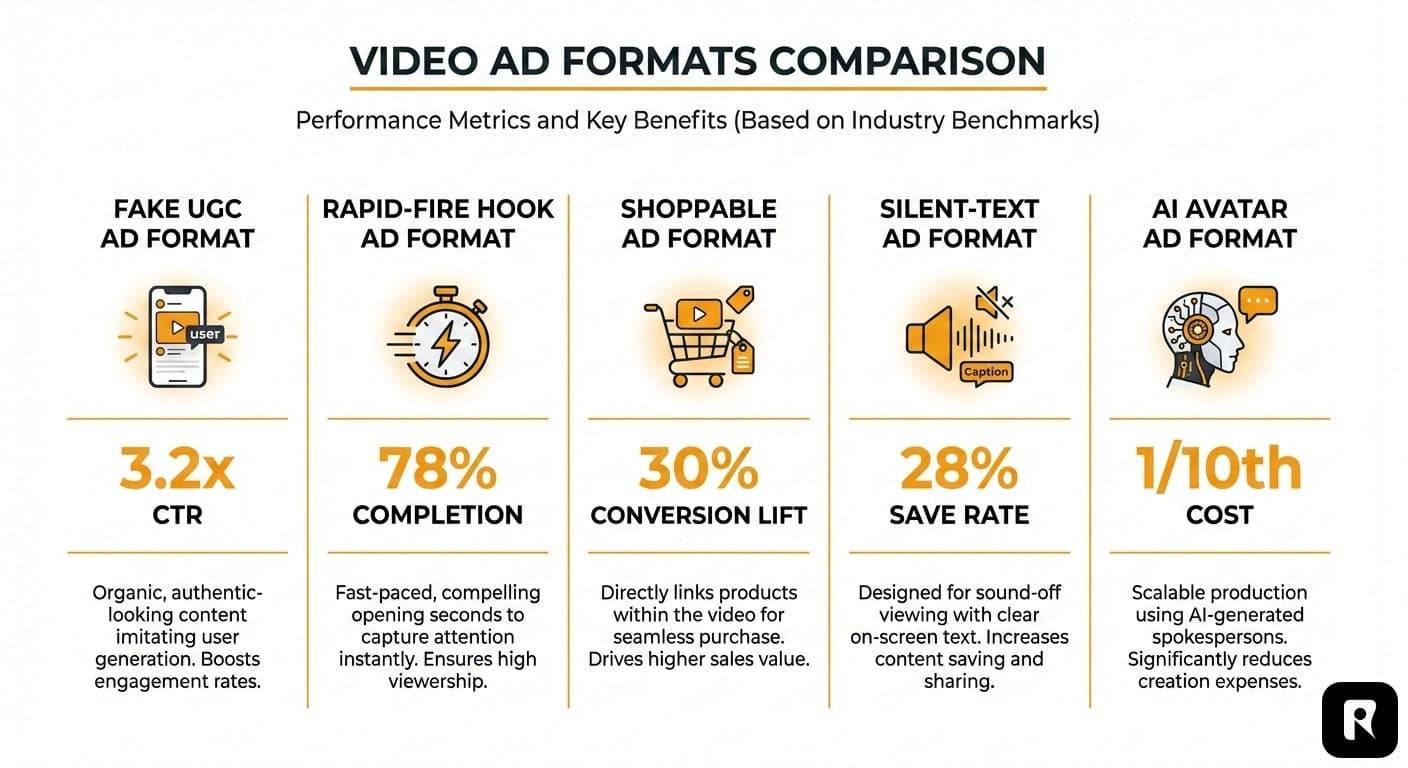
- Average CTR: 3.2x higher than traditional studio ads
- Average CPA: 47% lower than polished video production
- Best for: E-commerce, D2C brands, dropshipping
The UGC vs AI-generated video ads debate is essentially over. Advertisers who adopted AI-generated UGC in late 2025 are seeing comparable — and in some verticals, superior — conversion rates at a fraction of the cost. The key is making it feel genuine, not just technically good.
Skip the casting calls — generate UGC-style ads in minutes
Import your product, pick an AI actor, and get a UGC-style video ad ready to run. No filming, no editing, no freelancer delays.
Get your first video freeIncludes 1 free video and 150 credits. No credit card required.
2. The 3-Second Rapid-Fire Hook
If your ad doesn’t grab attention in the first 1.3 seconds, it’s invisible. The rapid-fire hook format is built entirely around this constraint — it front-loads a visual or verbal pattern interrupt that stops the scroll before the viewer consciously decides to keep going.
The four hook sub-formats dominating right now:
- Room Explosion: The camera starts on a normal scene, then the product “explodes” into frame with motion graphics. Extremely high stop rate on TikTok.
- Product Drop: A product falls from the top of frame and lands with a satisfying sound effect. Simple but gets 78% higher completion rates than standard intros.
- Text Flash: Bold, full-screen text appears for 0.5 seconds with a controversial or curiosity-driven statement before cutting to the presenter.
- Contradiction: The video opens with a statement that contradicts common belief. “Stop using moisturizer in the morning” — then explains why.
Pro tip: The best hook formats for viral video ads combine visual and verbal interrupts simultaneously. A text flash plus a contradictory voiceover outperforms either one alone. For 47 more hook ideas with examples, see our viral hook ideas guide.
Free Viral Hook Generator
Struggling to write hooks that stop the scroll? Generate 5 proven hook variations for your product instantly.
Try it free →3. Shoppable Video Ads
The biggest friction in social commerce has always been the gap between “I want this” and “I bought this.” Shoppable video ad formats eliminate that gap by embedding product tags, tap-to-buy overlays, and in-stream checkout directly into the video.
Every major platform now supports native shopping features:
- TikTok Shop: In-feed product cards with one-tap purchase. The dominant shoppable format in 2026.
- Instagram Shopping: Product tags in Reels with swipe-up checkout. Best for brands with curated aesthetics.
- YouTube Product Shelves: Product listings displayed below Shorts. Higher average order value than other platforms.
Shoppable video ads see a 30% higher conversion rate compared to standard link-in-bio flows. The key metric shift: instead of optimizing for click-through, you’re optimizing for in-stream purchase completion.
4. The Silent-Text Explainer
85% of social media video is watched without sound. The silent-text explainer format is designed entirely for this reality — bold, animated text overlays that tell the story without requiring a single word of audio.
This format works by combining fast-paced text animations with product B-roll, screen recordings, or simple demonstrations. The text does all the selling while the visuals provide proof.
- Save rate: 28% higher than voiced ads (users bookmark to revisit)
- Best platforms: Instagram Reels, LinkedIn Video
- Best verticals: SaaS, B2B, complex products, tutorials
The silent-text format also performs unusually well in international markets because there’s no language barrier in the audio track — just translate the text overlays.
5. AI Avatar Testimonials
Similar to the fake UGC format but with a specific twist: AI avatar testimonials use AI-generated presenters to deliver scripted reviews, product comparisons, and “honest opinion” style content. The big advantage is scale — you can generate dozens of variations with different actors, scripts, and angles in hours instead of weeks.
Advertisers running AI avatar testimonials report conversion rates comparable to real UGC creators at roughly 1/10th the production cost. The key to making them work: choosing the right actor for your target demographic and writing scripts that sound natural, not robotic.
Why actor selection matters: The same script delivered by different AI actors can see conversion differences of 3–5x. Always test at least 3 different presenters per campaign. Match the actor’s age, style, and energy to your target audience.
What Works Where — Platform Breakdown
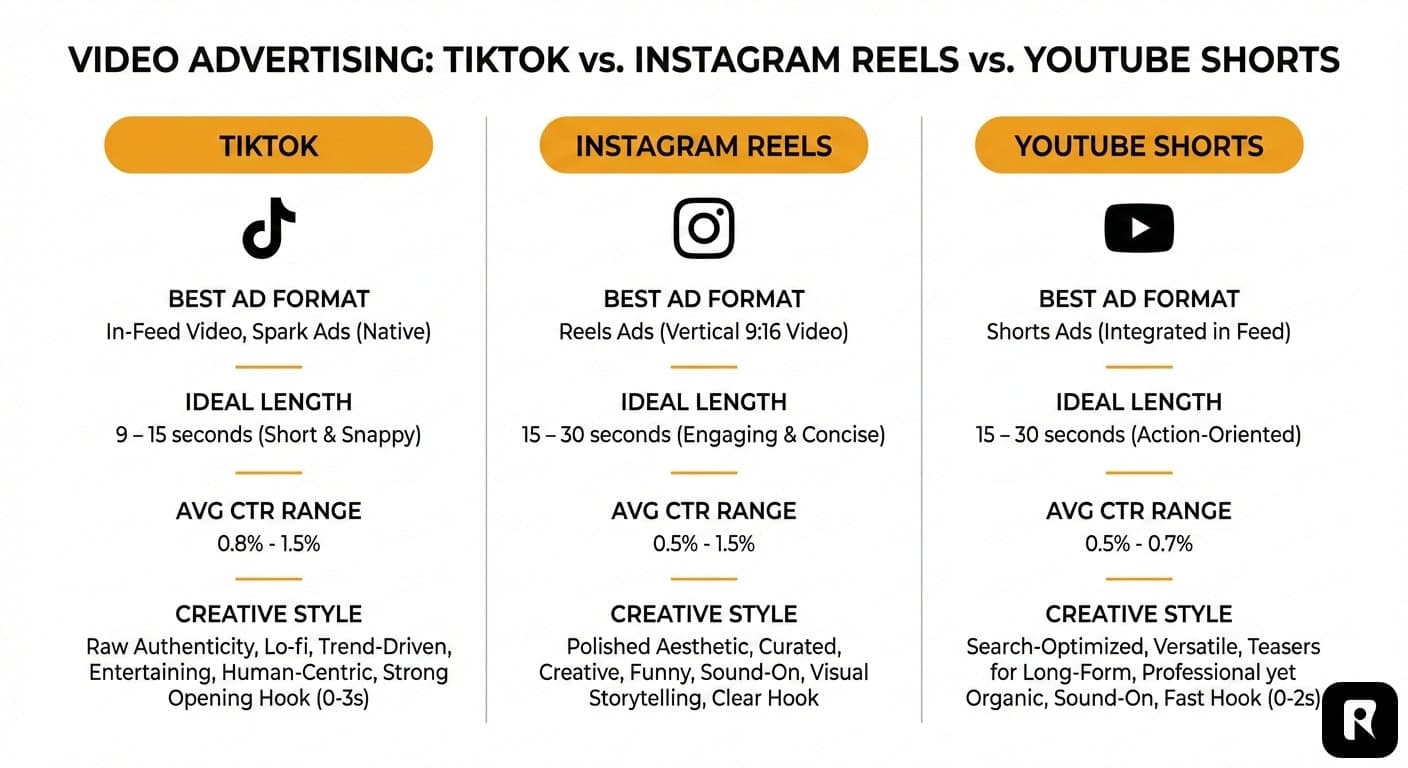
Not every format works equally well on every platform. Here’s how the best tiktok ad formats for e-commerce, Instagram Reels strategies, and YouTube Shorts approaches differ in 2026:
| Platform | Best Formats | Ideal Length | Avg CTR | Creative Style |
|---|---|---|---|---|
| TikTok | Fake UGC, Rapid-Fire Hook | 15–30s | 1.8–3.2% | Raw, unpolished, phone-shot feel |
| Instagram Reels | Silent-Text, Shoppable | 20–45s | 1.2–2.4% | Slightly more curated aesthetic |
| YouTube Shorts | AI Avatar, Explainer | 30–60s | 0.8–1.6% | Higher intent, more informational |
TikTok rewards content that feels genuinely native. The algorithm actively deprioritizes anything that looks over-produced. Fake UGC and rapid-fire hooks dominate because they mirror what organic creators post. The sweet spot is 15–30 seconds — long enough to tell a story, short enough to hold attention. Need scripts for TikTok specifically? Try our free TikTok script generator.
Instagram Reels skews slightly more polished. Silent-text explainers perform well here because Instagram’s audience is more likely to watch without sound, and shoppable formats benefit from Instagram’s built-in shopping infrastructure.
YouTube Shorts has a higher-intent audience. People on YouTube are actively seeking information, which makes AI avatar explainers and testimonial-style formats outperform pure entertainment hooks. YouTube Shorts ad conversion rates are typically lower in raw CTR but higher in average order value.
How to Create These Formats with AI
A year ago, producing any of these formats required a real camera crew, actors, a video editor, and at least a week of turnaround. The total cost for a single ad variation: $500–$3,000. Want to A/B test 10 variations? Multiply that.
In 2026, the workflow for creating high-converting video ads with AI looks like this:
- Import your product: Drop in a URL or upload images. The AI extracts product details, benefits, and visual assets automatically.
- Generate the script: An AI writing engine creates a script optimized for the format you choose — fake UGC, hook-first, explainer, or testimonial.
- Select your AI actor: Choose from a library of presenters that match your target demographic. Age, style, energy — all selectable.
- Customize scenes: Add product shots, B-roll, text overlays, and scene transitions. Full control without touching a video editor.
- Export and test: Generate multiple variations with different hooks, actors, and scripts. Run them all and scale what converts.
Creating these formats used to take a video editor 4+ hours per variation. Tools like Retiplex let you generate AI video ads with unlimited actors, automatic script writing, and seamless product integration — going from product URL to finished ad in under 5 minutes. That speed advantage compounds fast when you’re testing 10–20 variations per campaign.
If you want to start with the script before generating the full video, you can use our free UGC script generator to brainstorm angles and hooks.
Which Format Should You Start With?
The best format depends on your business type, target platform, and budget. Here’s a quick decision framework:
Quick-start guide by business type:
- E-commerce / Dropshipping: Start with Fake UGC + Shoppable. Highest ROI for product-focused businesses.
- SaaS / B2B: Silent-Text Explainer + AI Avatar. Educate first, convert second.
- Local Business: AI Avatar Testimonials. Build trust with a familiar, friendly face.
- Content Creator / Agency: Rapid-Fire Hooks. Master attention-grabbing, then layer in the other formats.
Regardless of which format you start with, the same testing principle applies: produce 3–5 variations of your first ad, run them for 48–72 hours, kill the losers, and double down on the winner. The brands seeing the highest ROI from short-form video ads in 2026 aren’t the ones with the best single ad — they’re the ones testing the most variations.
The Bottom Line
The video ad landscape in 2026 rewards authenticity, speed, and volume. The five formats that convert — fake UGC, rapid-fire hooks, shoppable ads, silent-text explainers, and AI avatar testimonials — all share one thing in common: they feel like content, not commercials.
The platform matters too. Match your format to where your audience spends time: raw and chaotic for TikTok, slightly polished for Instagram, informational for YouTube Shorts.
And the single biggest competitive advantage? Production speed. The brands winning in 2026 aren’t spending more — they’re producing more variations faster, testing ruthlessly, and scaling what works. AI has made that possible for teams of any size.
For more on scripting these formats, check out our guides on writing TikTok scripts and UGC ad script structure.